Description
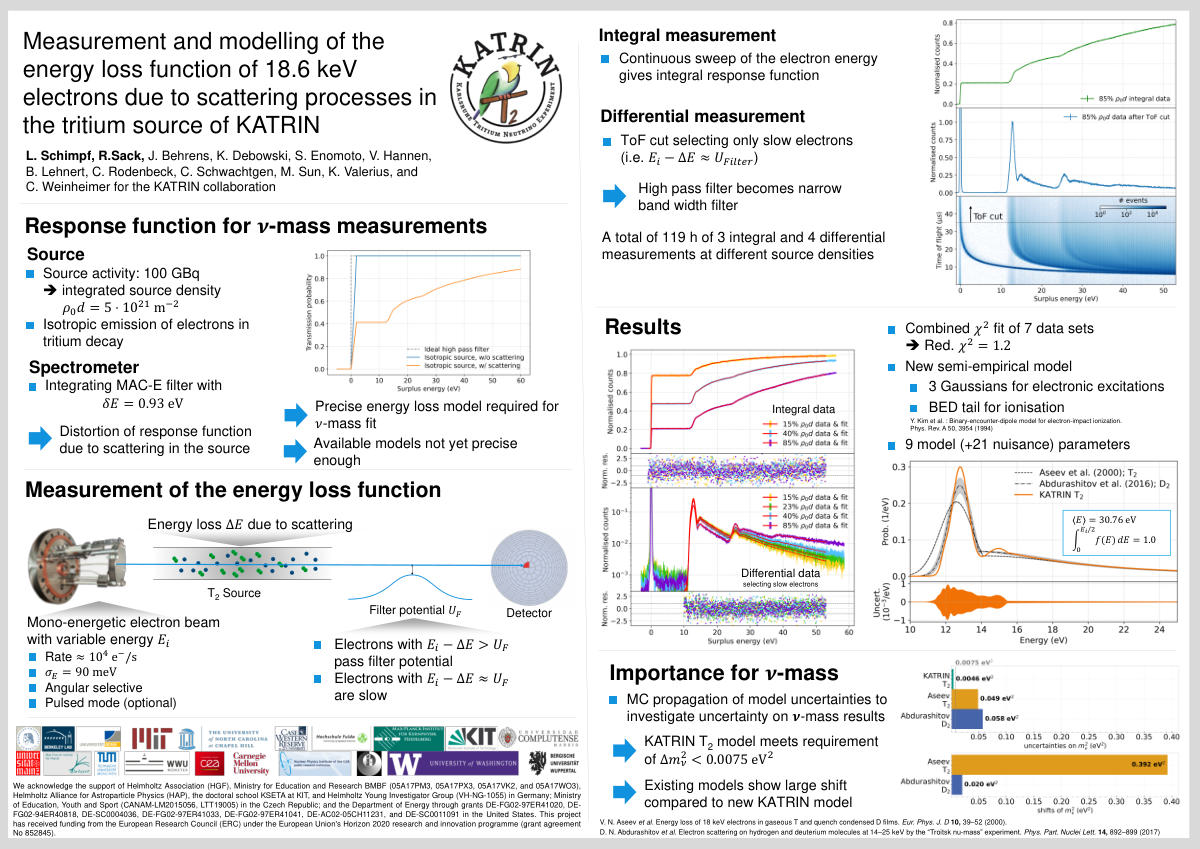
The Karlsruhe Tritium Neutrino experiment (KATRIN) is targeted to measure $m(\nu_e)$ with a sensitivity of 200 meV (90% C.L.). To determine the neutrino mass, the integrated $\beta$-spectrum of tritium is measured close to the endpoint and a fit to the data, comprising the neutrino mass as a free parameter, is performed. A number of systematic effects need to be taken into account in the analysis. One of the major effects is the energy loss from inelastic scattering of beta-electrons with the source gas. The corresponding energy loss function can be measured by means of an electron gun producing quasi-monoenergetic electrons at 18.6 keV with very small angular spread both in cw and pulsed mode. A new semi-empirical model has been developed based on the experimental data. This contribution presents the new model and its impact on the KATRIN neutrino mass sensitivity.
Conference Information
Identifiers
Authors
Jan Behrens
KIT
Rudolf Sack
KIT
Christian Weinheimer
KIT
Volker Hannen
KIT
Kathrin Valerius
KIT
Menglei Sun
KIT
Christophe Schwachtgen
KIT
Karol Debowski
KIT
Lutz Schimpf
KIT
Sanshiro Enomoto
KIT
Caroline Rodenbeck
KIT
Bjoern Lehnert
KIT