Description
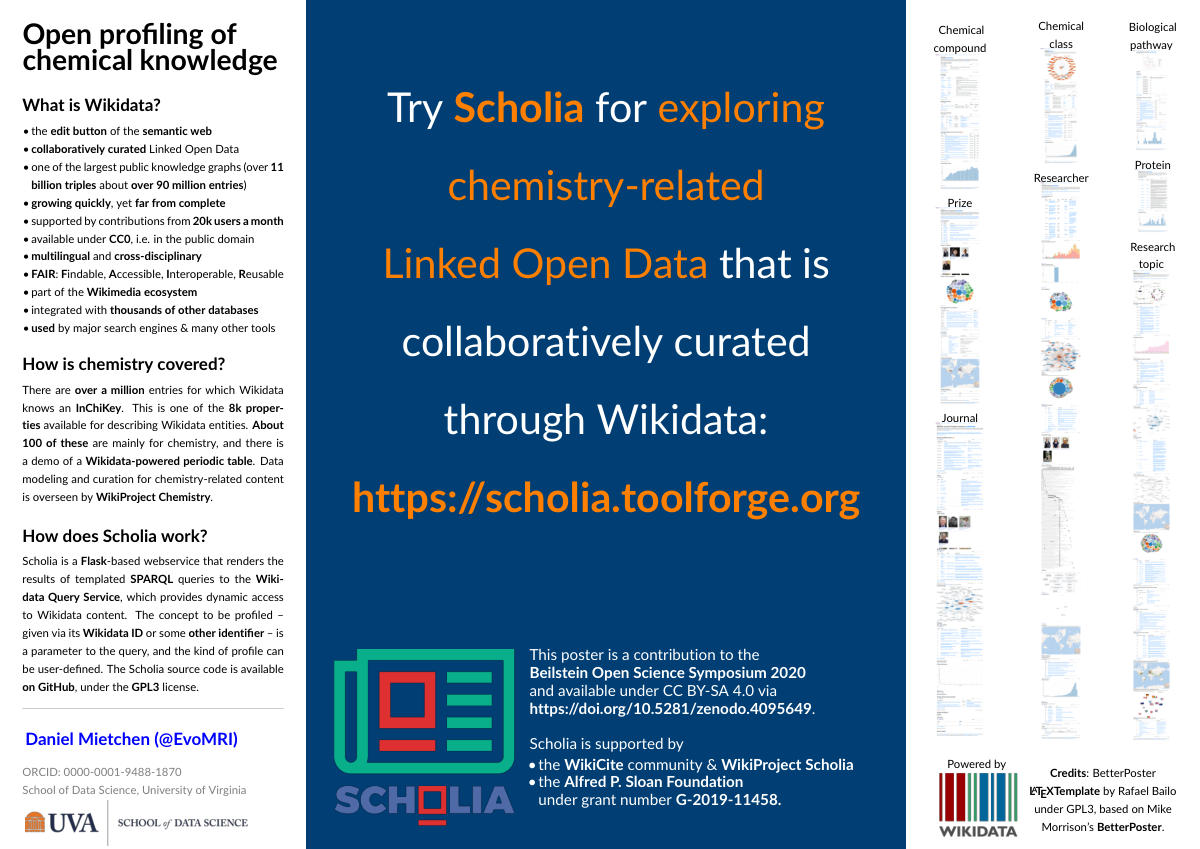
Note: the video is also available on Youtube via https://youtu.be/aM2pUMvg81o . Title Open profiling of chemical knowledge Abstract Chemical research — like research in general — takes place in a sociotechnical ecosystem that connects researchers, institutions, funders, databases, locations, publications, methodologies and related concepts with the objects of study and the natural and cultural worlds around them. Mechanisms for describing concepts related to chemistry are growing in breadth and depth, number and popularity. In parallel, more and more chemistry-related data — and particularly metadata — are being made available under open licenses, which facilitates discoverability, reproducibility and reuse, as well as data integration. Wikidata is a community-curated open knowledge base in which concepts covered in any Wikipedia — and beyond — can be described in a structured and FAIR fashion that can be mapped to RDF and queried using SPARQL as well as various other means. Its community of over 20,000 monthly contributors oversees a corpus of currently over 90 million 'items’ for concepts that are linked amongst each other, to external databases or to specific values via over 7000 'properties'. Items and properties have persistent unique identifiers, to which labels, descriptions and dedicated lexemes and their forms and senses can be attached in over 300 natural languages. A range of open-source tools is available to interact with Wikidata — to enter information, curate and query it. In this presentation — which shall be available via https://doi.org/10.5281/zenodo.4095649 — we will use examples from chemistry to take a look at Scholia — available via https://scholia.toolforge.org/ — which allows to generate and explore Wikidata-based scholarly profiles of research topics, authors, institutions, funders and other parts of the research ecosystem, as well as of the world in which it is embedded.
Conference Information
Beilstein Open Science Symposium
Identifiers
Authors
Daniel Mietchen
School of Data Science, University of Virginia, USA
ORCID: https://orcid.org/0000-0001-9488-1870