Description
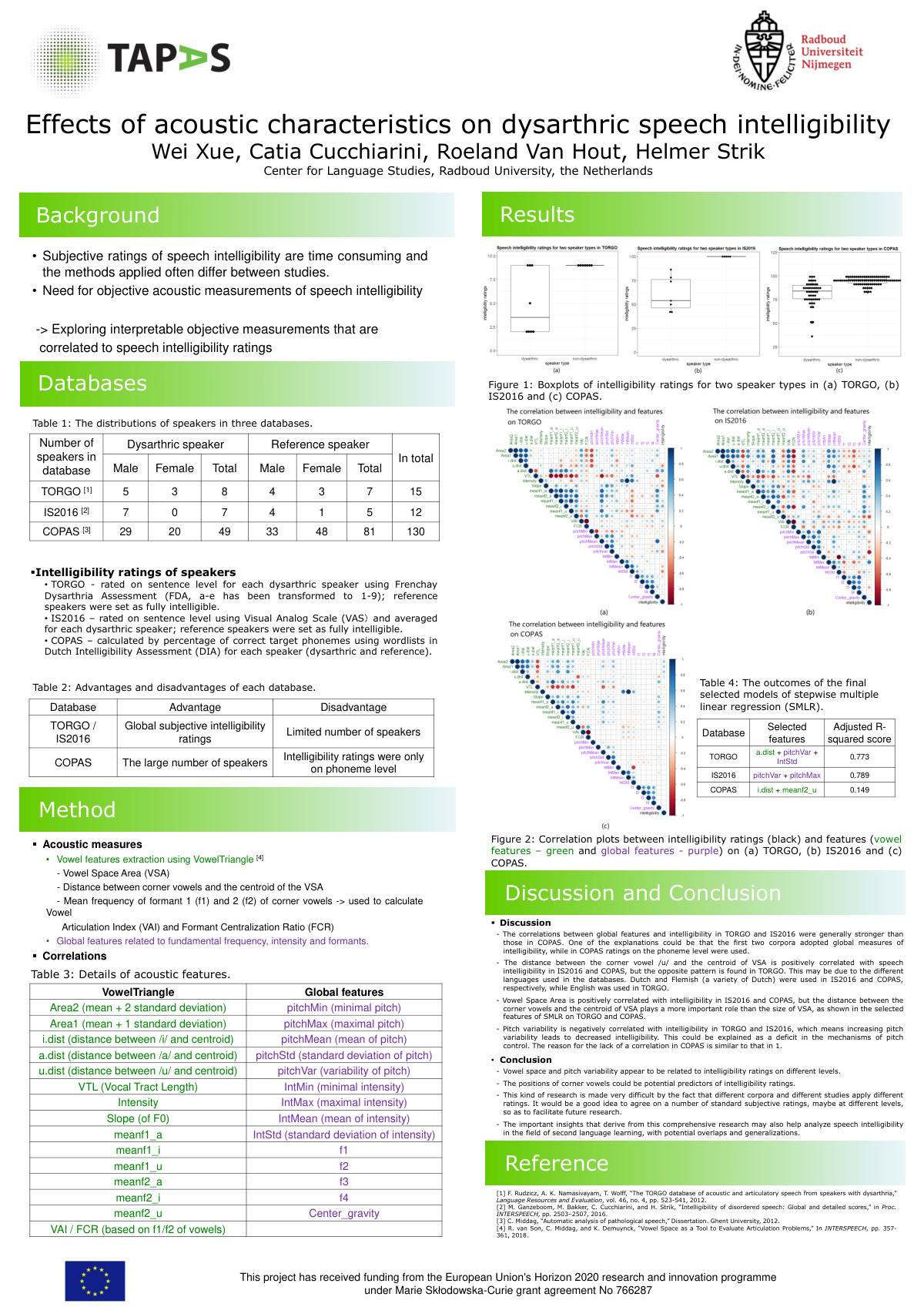
Research on speech intelligibility takes place in many domains, e.g. clinical, language learning, psycholinguistics, and speech synthesis. Although intelligibility rating has received considerable attention, it's still unclear that which features of speech contribute most significantly to intelligibility and there are no general measurement procedures. In addition, measuring speech intelligibility is time-consuming since it is usually measured by collecting subjective judgments of human raters. Due to these limitations, there is a growing need to develop more objective procedures for measuring speech intelligibility base on efficient computational models. This is important for research and practice, such as diagnosis, pre- and post-tests, and monitoring purposes. In a previous study (Ganzeboom et al., 2016), we investigated a set of intelligibility ratings of disordered speech at three different levels of granularity: utterance, word, and subword level. Orthographic transcriptions were used to obtain word and subword (grapheme and phoneme) level ratings by using automatic alignment and conversion methods. The obtained phoneme scoring thus turned out to be feasible, reliable and provided a more sensitive and informative measure of intelligibility. However, all the methods presented in this study were dependent on subjective ratings provided by human judges. Recently, we investigated what deviations of pathological speech mostly influenced speech intelligibility by automatically calculating several acoustic characteristics of vowel sounds on a Dutch dataset and on the English dataset TORGO. Preliminary results seem to indicate that normalized Vowel Space Area, Vowel Articulatory Index, and (variation in) fundamental frequency (F0) appear to be related to intelligibility. This is in line with previous research (Tjaden, et al., 2013; Skodda, et al., 2012) and with studies on the intelligibility of L2 speech (Kang et al., 2018). We will also discuss possible avenues for future research and implications for clinical practice.
Identifiers
Funding Information
European Commission
Training Network on Automatic Processing of PAthological Speech
Grant: 766287
Award detailsAuthors
Wei Xue
Radboud University
ORCID: https://orcid.org/0000-0001-9498-3519
Catia Cucchiarini
Radboud University
Roeland Van Hout
Radboud University
Helmer Strik
Radboud University