Description
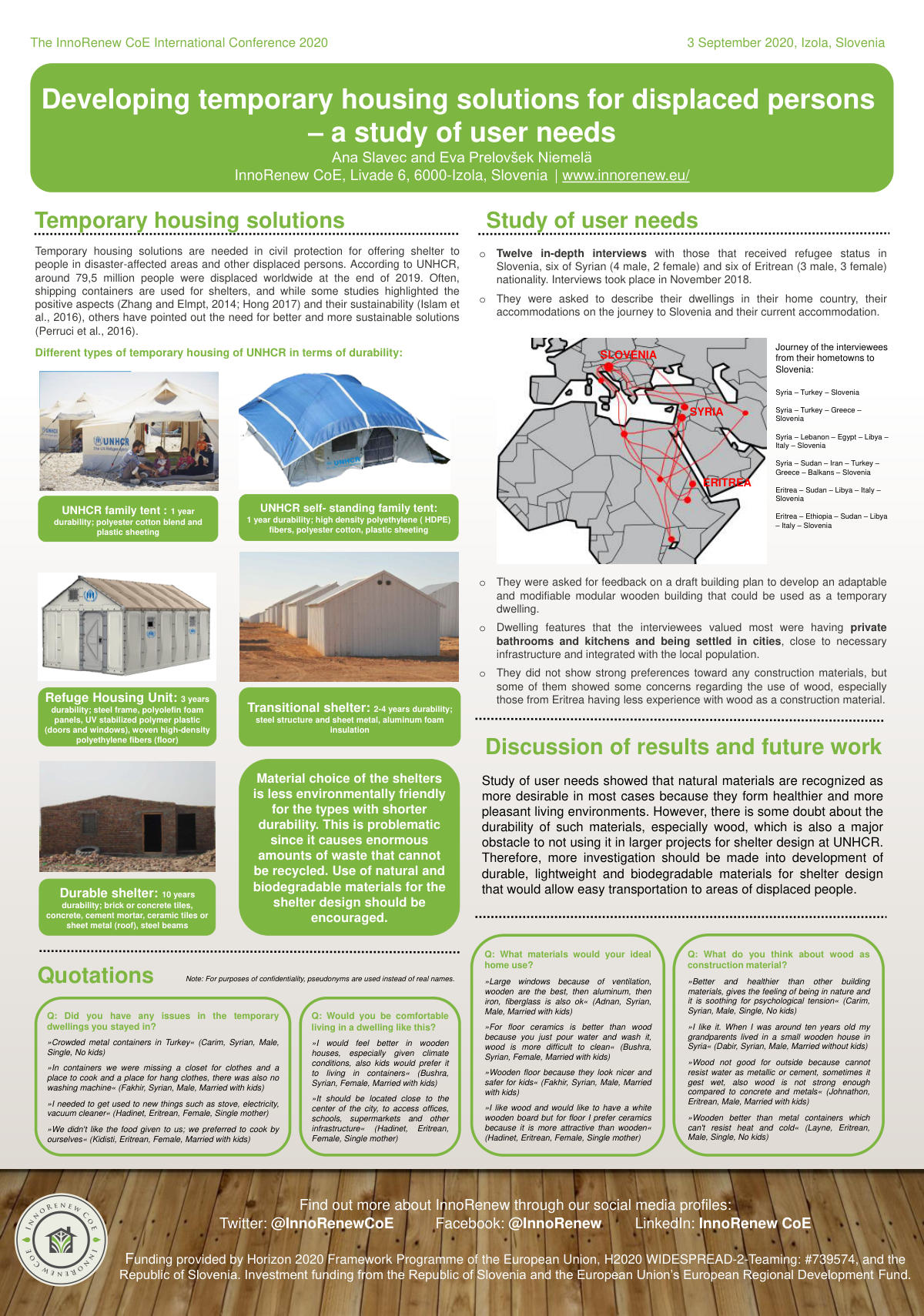
Temporary housing solutions are needed in civil protection for offering shelter to people in disaster-affected areas and other displaced persons. Often, shipping containers are used for this purpose, and while some studies highlighted the positive aspects (Zhang and Elmpt, 2014; Hong 2017) and their sustainability (Islam et al., 2016), others have pointed out the need for better and more sustainable solutions (Perruci et al., 2016). In this paper, we identify different types of temporary housing according to two main distinct categories of temporary dwellings (Abulnour, 2013): temporary shelter and temporary house. We study them from the functional and technical perspective, their sustainability aspects, use of bio-based materials and reuse at the end of their life cycle. The aim of this paper is to give further recommendations for the construction of environmentally and socially sustainable temporary dwellings. Sustainable shelter design is of major importance, particularly for European regions, since laws for public procurement follow rules of green purchasing. We identify desired characteristics of temporary dwellings based on twelve in-depth interviews with those that received refugee status in Slovenia, six of Syrian and six of Eritrean nationality. Participants were asked to describe their dwellings in their home country, their accommodations on the journey to Slovenia and their current accommodation. In addition, they were asked for feedback on a draft building plan to develop an adaptable and modifiable modular wooden building that could be used as a temporary dwelling. Dwelling features that the interviewees valued most were having private bathrooms and kitchens and being settled in cities, close to necessary infrastructure and integrated with the local population. They did not show strong preferences toward any construction materials, but some of them showed some concerns regarding the use of wood, especially those from Eritrea having less experience with wood as a construction material.
Conference Information
The InnoRenew CoE International Conference 2020
Identifiers
Funding Information
European Commission
Renewable materials and healthy environments research and innovation centre of excellence (InnoRenew CoE)
Grant: 664331
Award detailsAuthors
Ana Prelovšek
Eva Prelovsek Niemela