Electron microscopy study of nanocrystalline wurtzite ZnS produced via a co-precipitation technique and its pyroelectric ceramics processed by 2-step-pressureless sintering
Description
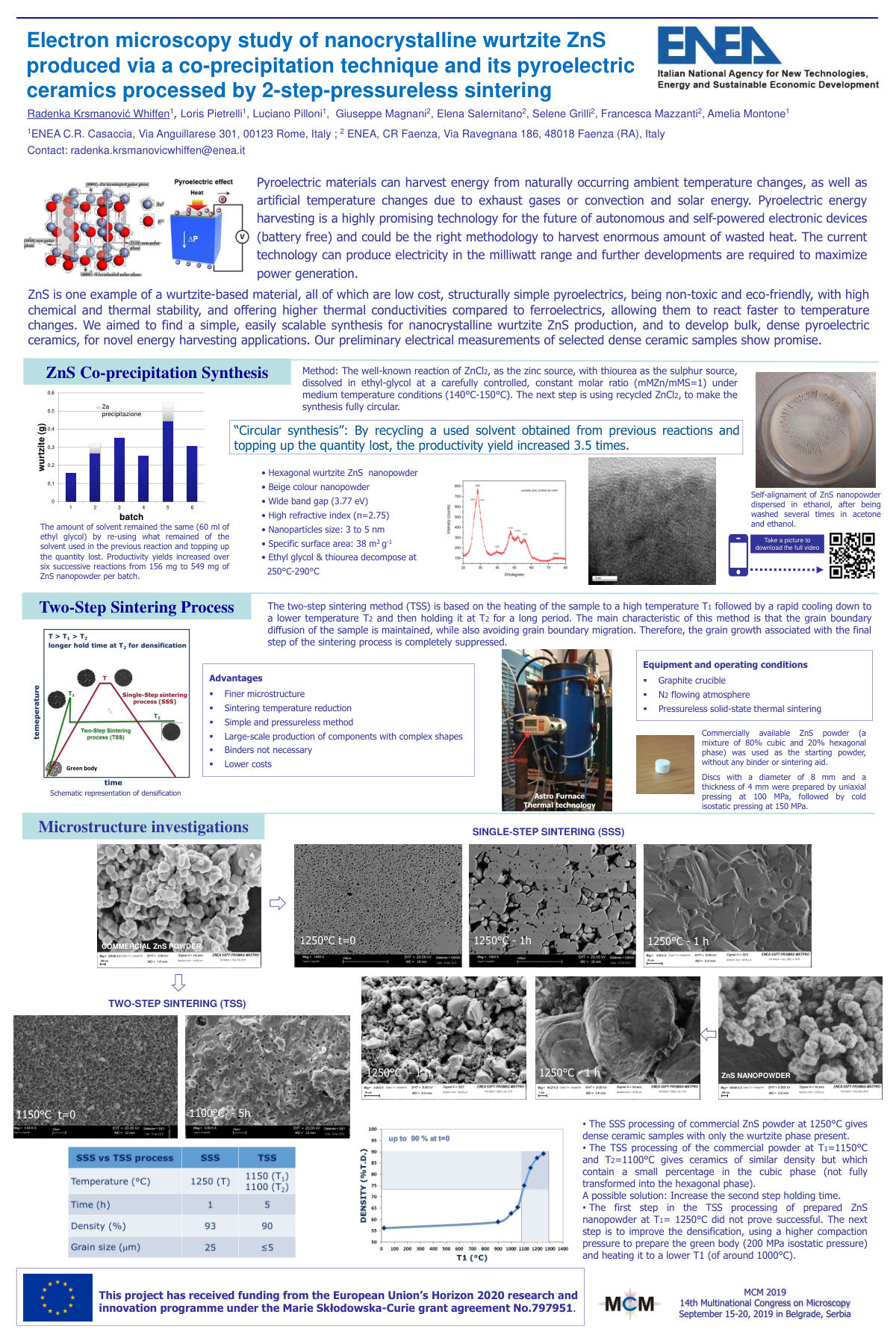
The pyroelectric performances of non-ferroelectric pyroelectrics like wurtzite- based materials (e.g. AlN, GaN, CdS or ZnO) make them important, although not widely used, compared to the current state-of-the-art ferroelectrics. Their high chemical and thermal stability allows their use at high temperatures in air, whereas ferroelectrics become ineffective when heated beyond their Curie temperature (TC). Wurtzite based materials have a higher thermal conductivity allowing them to react faster to ambient temperature changes, their raw material costs are lower and many of them are eco-friendly. Current pyroelectrics applications are limited to portable systems or tasks needing only μW–mW power. To be commercially viable, we must improve the current low efficiency of pyroelectric systems and intrinsically enhance the pyroelectric properties of modern materials through suitable doping or material engineering. We chose to study hexagonal wurtzite phase of ZnS, among the structurally simplest of pyroelectrics, as a possible energy harvesting material. An easy synthesis method – a co-precipitation technique, was tailored for nanocrystalline wurtzite ZnS production. This method is easy to scale-up and our next step is to build an in-house pilot plant that will produce substantial amounts of wurtzite ZnS nano-powder in an environmentally friendly and cost-effective manner. We further investigated the development of bulk, dense pyroelectric ceramics by the Two-Step Sintering (TSS) fabrication process, using as the precursor material both a micron-sized commercial powder of the ZnS cubic and hexagonal phases mixture, and an in-house produced wurtzite ZnS nanopowder. The TSS was chosen as being a pressureless, simple and cost‐effective sintering method for obtaining high density materials with controlled grain growth operating at a lower temperature than the conventiona process. Electron Microscopy techniques helped us to study the microstructure and morphology of both the precursor nanopowders and the obtained ceramics. Acknowledgement: This project has received funding from the European Union’s Horizon 2020 research and innovation programme under the Marie Skłodowska-Curie grant agreement No. 797951.
Conference Information
MCM2019 14th MULTINATIONAL CONGRESS ON MICROSCOPY
Identifiers
Funding Information
European Commission
ZnS Wurtzite Nanotextured Ceramic Materials for Pyroelectric Energy Harvesting
Grant: 797951
Award detailsAuthors
Radenka Krsmanovic Whiffen
ENEA CR Casaccia
ORCID: https://orcid.org/0000-0001-7136-3384
Loris Pietrelli
ENEA CR Casaccia
ORCID: https://orcid.org/0000-0002-3825-1468
Luciano Pilloni
ENEA CR Casaccia
Giuseppe Magnani
ENEA CR Faenza
Elena Salernitano
ENEA CR Faenza
Selene Grilli
ENEA CR Faenza
Francesca Mazzanti
ENEA CR Faenza
Amelia Montone
ENEA CR Casaccia