Description
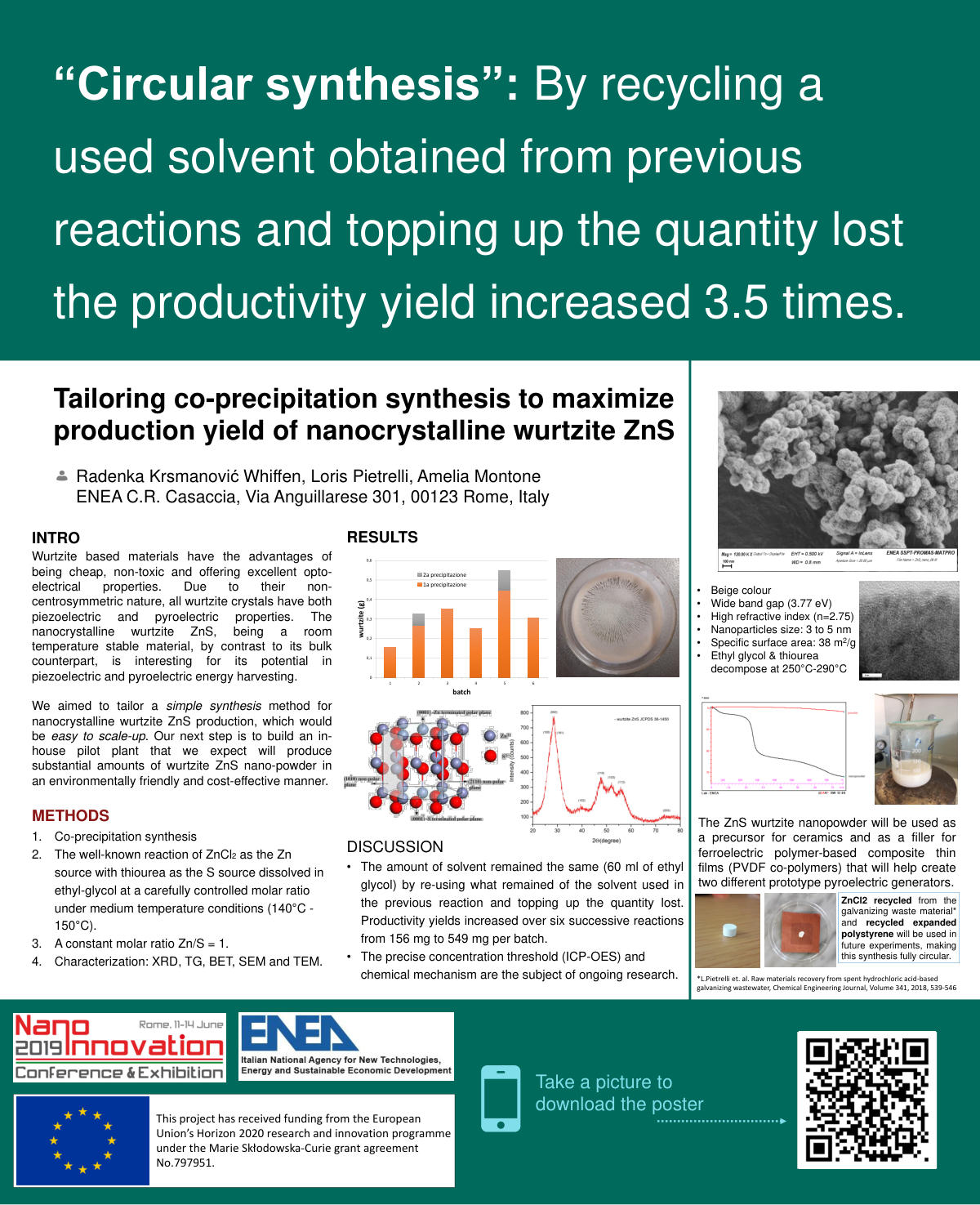
Wurtzite based materials have the advantages of being cheap, no-toxic and offering excellent opto-electrical, piezoelectric and pyroelectric properties. The nanocrystalline wurtzite ZnS, being a room temperature stable material unlike its bulk counterpart, is interesting because of its potential in piezoelectric and pyroelectric energy harvesting. In this work we aimed to tailor a simple synthesis method for nanocrystalline wurtzite production, which would be easy to scale up. We used the well-known reaction of zinc chloride with thiourea or sodium sulfide dissolved in ethyl glycol at a carefully controlled molar ratio in medium temperature conditions (140-150°C) to produce pure, nanocrystalline ZnS in the hexagonal (wurtzite) phase, via a series of consecutive experiments. The amount of solvent was kept the same (60 ml of ethyl glycol) by re-using what remained of the solvent from the previous reaction and topping up the quantity lost. The productivity yield increased over 6 successive reactions from 156 mg to 446 mg per batch at a constant mMZn/mMS = 1 ratio. The obtained nanopowder has been characterized using TG, BET, FTIR, TEM and SEM techniques. Our plan is to build an in-house pilot plant that should produce substantial amounts of wurtzite ZnS nano-powder in an environmentally friendly and cost effective way. Acknowledgement: This project has received funding from the European Union’s Horizon 2020 research and innovation programme under the Marie Skłodowska-Curie grant agreement No. 797951.
Conference Information
NanoInnovation 2019 Conference & Exhibition
Identifiers
Funding Information
European Commission
ZnS Wurtzite Nanotextured Ceramic Materials for Pyroelectric Energy Harvesting
Grant: 797951
Award detailsAuthors
Radenka Krsmanovic Whiffen
ENEA
ORCID: https://orcid.org/0000-0001-7136-3384
Loris Pietrelli
ENEA
ORCID: https://orcid.org/0000-0002-3825-1468
Amelia Montone
ENEA
Leeroy Jenkins
author2