Description
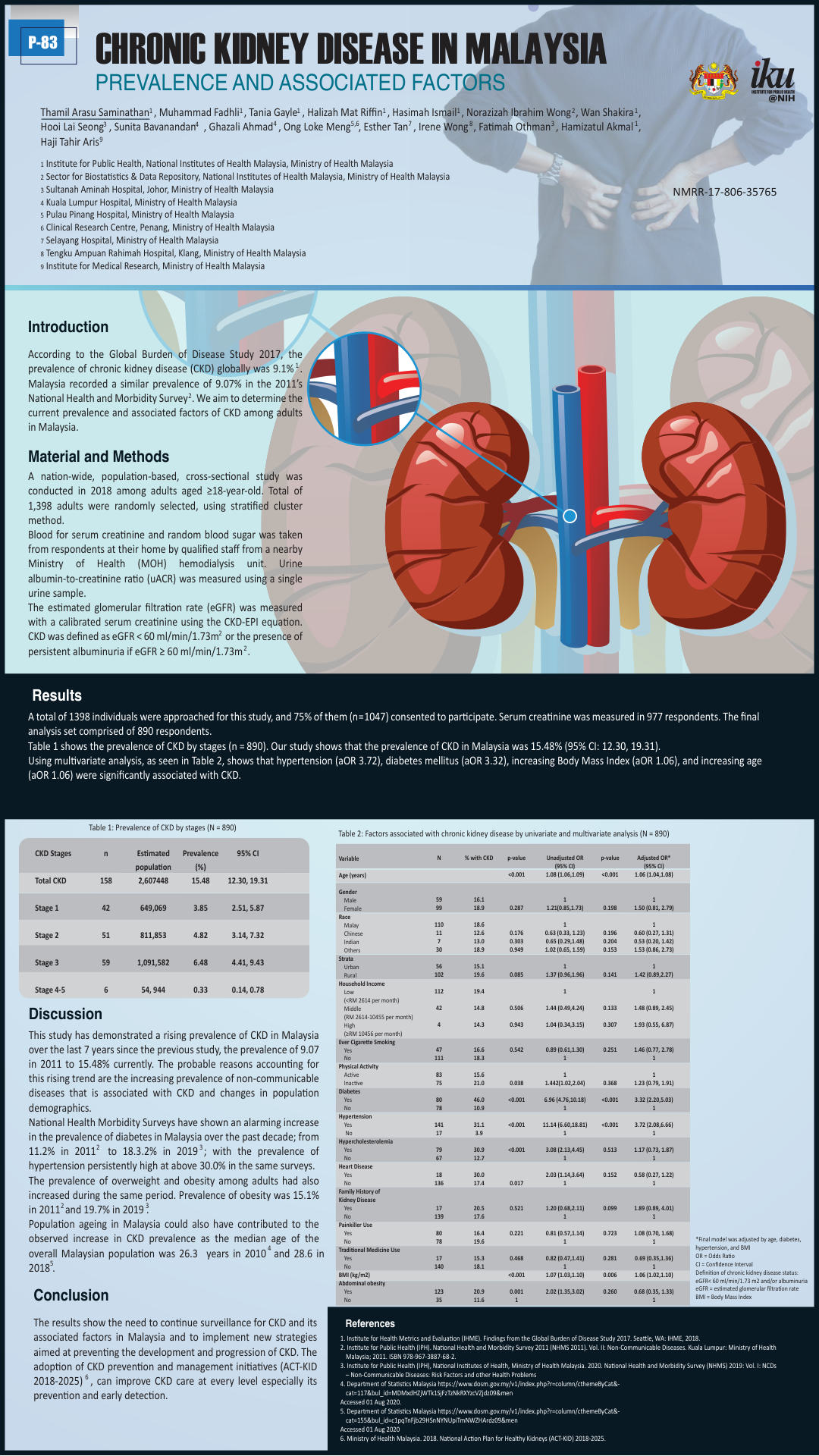
Introduction According to the Global Burden of Disease Study 2017, the prevalence of chronic kidney disease (CKD) globally was 9.1% . Malaysia recorded a similar prevalence of 9.07% in the 2011’s National Health and Morbidity Survey . We aim to determine the current prevalence and associated factors of CKD among adults in Malaysia. Materials and Methods A nation-wide, population-based, cross-sectional study was conducted in 2018 among adults aged ≥18-year-old. Total of 1,398 adults were randomly selected, using stratified cluster method. Blood for serum creatinine and random blood sugar was taken from respondents at their home by qualified staff from a nearby Ministry of Health (MOH) hemodialysis unit. Urine albumin-to-creatinine ratio (uACR) was measured using a single urine sample. The estimated glomerular filtration rate (eGFR) was measured with a calibrated serum creatinine using the CKD-EPI equation. CKD was defined as eGFR < 60 ml/min/1.73m or the presence of persistent albuminuria if eGFR ≥ 60 ml/min/1.73m . Results A total of 1398 individuals were approached for this study, and 75% of them (n = 1047) consented to participate. Serum creatinine was measured in 977 respondents. The final analysis set comprised of 890 respondents. Table 1 shows the prevalence of CKD by stages (n = 890). Our study shows that the prevalence of CKD in Malaysia was 15.48% (95% CI: 12.30, 19.31). Using multivariate analysis, as seen in Table 2, shows that hypertension (aOR 3.72), diabetes mellitus (aOR 3.32), increasing Body Mass Index (aOR 1.06), and increasing age (aOR 1.06) were significantly associated with CKD. Discussion This study has demonstrated a rising prevalence of CKD in Malaysia over the last 7 years since the previous study, the prevalence of 9.07 in 2011 to 15.48% currently. The probable reasons accounting for this rising trend are the increasing prevalence of non-communicable diseases that is associated with CKD and changes in population demographics. National Health Morbidity Surveys have shown an alarming increase in the prevalence of diabetes in Malaysia over the past decade; from 11.2% in 2011 to 18.3.2% in 2019 ; with the prevalence of hypertension persistently high at above 30.0% in the same surveys. The prevalence of overweight and obesity among adults had also increased during the same period. Prevalence of obesity was 15.1% in 2011 and 19.7% in 2019 . Population ageing in Malaysia could also have contributed to the observed increase in CKD prevalence as the median age of the overall Malaysian population was 26.3 years in 2010 and 28.6 in 2018 . Conclusion The results show the need to continue surveillance for CKD and its associated factors in Malaysia and to implement new strategies aimed at preventing the development and progression of CKD. The adoption of CKD prevention and management initiatives (ACT-KID 2018-2025) , can improve CKD care at every level especially its prevention and early detection.
Conference Information
P-83
Identifiers
Authors
Thamil Arasu Saminathan
Institute for Public Health, National Institutes of Health, Ministry of Health Malaysia
ORCID: https://orcid.org/0000-0002-8342-0777
Muhammad Fadhli
Institute for Public Health, National Institutes of Health, Ministry of Health Malaysia
ORCID: https://orcid.org/0000-0001-8006-8723
Tania Gayle
Institute for Public Health, National Institutes of Health, Ministry of Health Malaysia
ORCID: https://orcid.org/0000-0002-0313-2821
Halizah Mat Riffin
Institute for Public Health, National Institutes of Health, Ministry of Health Malaysia
ORCID: https://orcid.org/0000-0002-5067-5677
Hasimah Ismail
Institute for Public Health, National Institutes of Health, Ministry of Health Malaysia
ORCID: https://orcid.org/0000-0002-2311-580X
Norazizah Ibrahim Wong
Sector for Biostatistics & Data Repository, National Institutes of Health (NIH), Ministry of Health, Malaysia
Wan Shakira
Institute for Public Health, National Institutes of Health, Ministry of Health Malaysia
Hooi Lai Seong
Sultanah Aminah Hospital, Johor, Ministry of Health Malaysia
Sunita Bavanandan
Kuala Lumpur Hospital, Ministry of Health Malaysia
Ghazali Ahmad
Kuala Lumpur Hospital, Ministry of Health Malaysia
Ong Loke Meng
Pulau Pinang Hospital, Ministry of Health Malaysia
Esther Tan
Hospital Selayang, Ministry of Health, Malaysia
Irene Wong
Tengku Ampuan Rahimah Hospital, Klang, Ministry of Health Malaysia
Fatimah Othman
Sultanah Aminah Hospital, Johor, Ministry of Health Malaysia
Hamizatul Akmal
Institute for Public Health, National Institutes of Health, Ministry of Health Malaysia
Haji Tahir Aris
Institute for Medical Research, Ministry of Health, Malaysia