Description
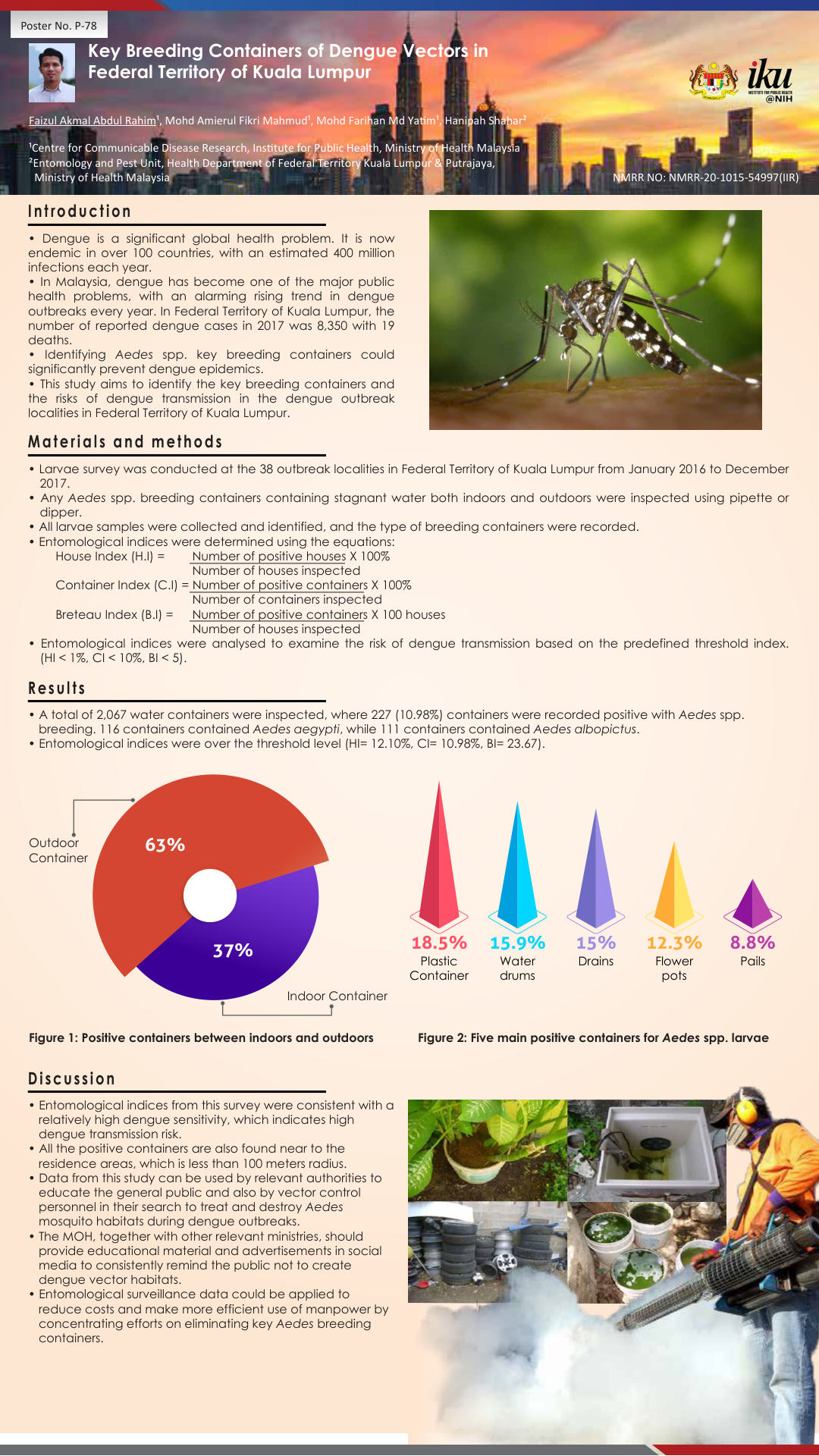
introduction Dengue is a significant global health problem. It is now endemic in over 100 countries, with an estimated 400 million infections each year. In Malaysia, dengue has become one of the major public health problems, with an alarming rising trend in dengue outbreaks every year. In Federal Territory of Kuala Lumpur, the number of reported dengue cases in 2017 was 8,350 with 19 deaths. Identifying Aedes spp. key breeding containers could significantly prevent dengue epidemics. This study aims to identify the key breeding containers and the risks of dengue transmission in the dengue outbreak localities in Federal Territory of Kuala Lumpur. Materials and Methods Larvae survey was conducted at the 38 outbreak localities in Federal Territory of Kuala Lumpur from January 2016 to December 2017. Any Aedes spp. breeding containers containing stagnant water both indoors and outdoors were inspected using pipette or dipper. All larvae samples were collected and identified, and the type of breeding containers were recorded. Results A total of 2,067 water containers were inspected, where 227 (10.98%) containers were recorded positive with Aedes spp. breeding. 116 containers contained Aedes aegypti, while 111 containers contained Aedes albopictus. Entomological indices were over the threshold level (HI= 12.10%, CI= 10.98%, BI= 23.67). Discussion Entomological indices from this survey were consistent with a relatively high dengue sensitivity, which indicates high dengue transmission risk. All the positive containers are also found near to the residence areas, which is less than 100 meters radius. Data from this study can be used by relevant authorities to educate the general public and also by vector control personnel in their search to treat and destroy Aedes mosquito habitats during dengue outbreaks. The MOH, together with other relevant ministries, should provide educational material and advertisements in social media to consistently remind the public not to create dengue vector habitats. Entomological surveillance data could be applied to reduce costs and make more efficient use of manpower by concentrating efforts on eliminating key Aedes breeding containers.
Identifiers
Authors
Faizul Akmal Abdul Rahim
Center For Communicable Diseases Research, Institute For Public Health, Ministry of Health Malaysia
ORCID: https://orcid.org/0000-0002-7278-7645
Mohd Amierul Fikri Mahmud
Center For Communicable Diseases Research, Institute For Public Health, Ministry of Health Malaysia
ORCID: https://orcid.org/0000-0002-9366-8354
Mohd Farihan Md Yatim
Center For Communicable Diseases Research, Institute For Public Health, Ministry of Health Malaysia
ORCID: https://orcid.org/0000-0001-6723-8003
Hanipah Shahar
Entomology and Pest Unit, Health Department of Federal Territory Kuala Lumpur & Putrajaya, Ministry of Health Malaysia