Description
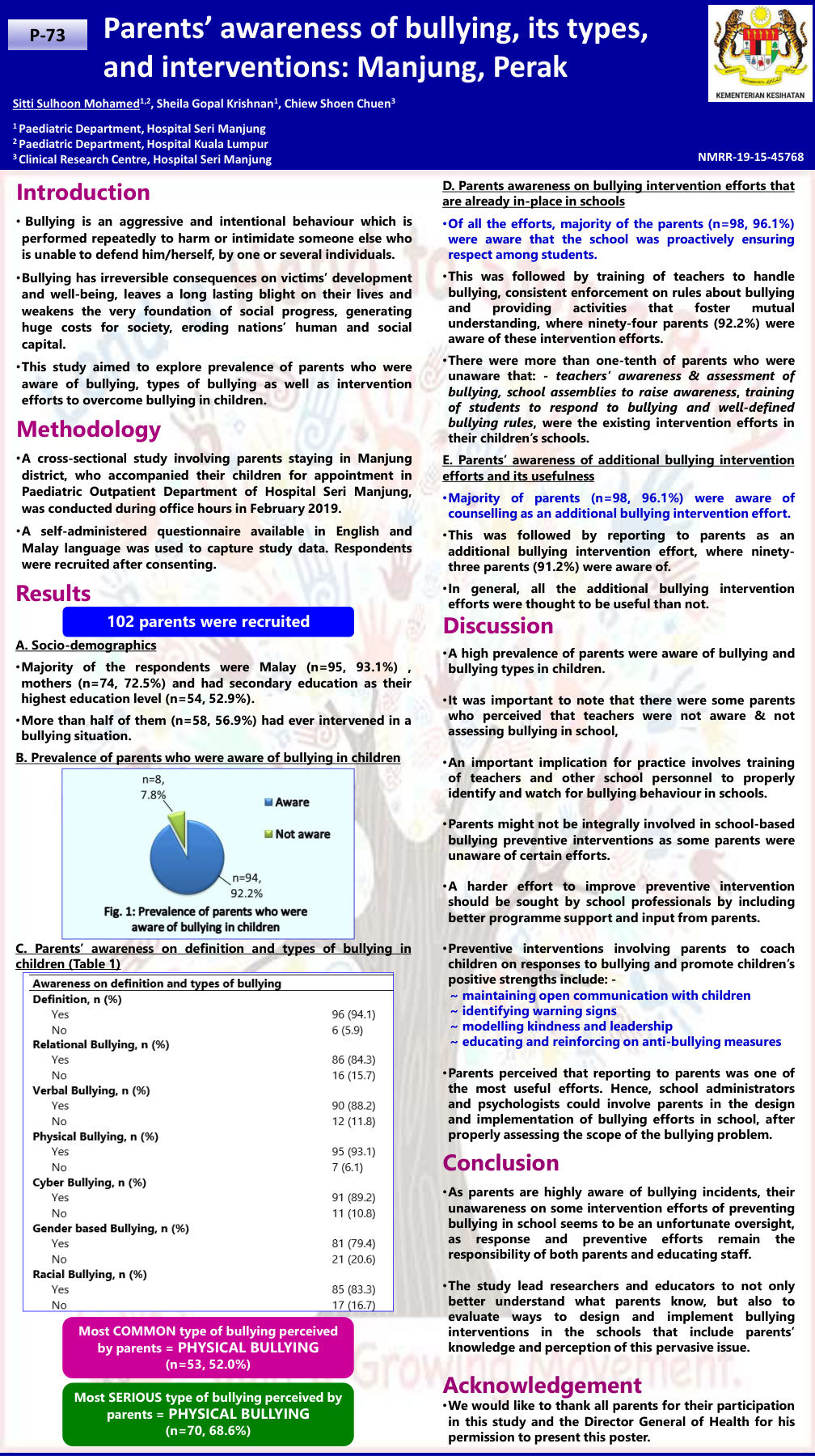
Introduction Bullying is an aggressive and intentional behaviour which is performed repeatedly to harm or intimidate someone else who is unable to defend him/herself, by one or several individuals. Bullying has irreversible consequences on victims’ development and well-being, leaves a long lasting blight on their lives and weakens the very foundation of social progress, generating huge costs for society, eroding nations’ human and social capital. This study aimed to explore prevalence of parents who were aware of bullying, types of bullying as well as intervention efforts to overcome bullying in children. Methodology A cross-sectional study involving parents staying in Manjung district, who accompanied their children for appointment in Paediatric Outpatient Department of Hospital Seri Manjung, was conducted during office hours in February 2019. A self-administered questionnaire available in English and Malay language was used to capture study data. Respondents were recruited after consenting. Results A. Socio-demographics Majority of the respondents were Malay (n=95, 93.1%) , mothers (n=74, 72.5%) and had secondary education as their highest education level (n=54, 52.9%). More than half of them (n=58, 56.9%) had ever intervened in a bullying situation. B. Prevalence of parents who were aware of bullying in children C. Parents’ awareness on definition and types of bullying in children (Table 1) D. Parents awareness on bullying intervention efforts that are already in-place in schools Of all the efforts, majority of the parents (n=98, 96.1%) were aware that the school was proactively ensuring respect among students. This was followed by training of teachers to handle bullying, consistent enforcement on rules about bullying and providing activities that foster mutual understanding, where ninety-four parents (92.2%) were aware of these intervention efforts. There were more than one-tenth of parents who were unaware that: - teachers’ awareness & assessment of bullying, school assemblies to raise awareness, training of students to respond to bullying and well-defined bullying rules, were the existing intervention efforts in their children’s schools. E. Parents’ awareness of additional bullying intervention efforts and its usefulness Majority of parents (n=98, 96.1%) were aware of counselling as an additional bullying intervention effort. This was followed by reporting to parents as an additional bullying intervention effort, where ninetythree parents (91.2%) were aware of. In general, all the additional bullying intervention efforts were thought to be useful than not. Discussion A high prevalence of parents were aware of bullying and bullying types in children. It was important to note that there were some parents who perceived that teachers were not aware & not assessing bullying in school, An important implication for practice involves training of teachers and other school personnel to properly identify and watch for bullying behaviour in schools. Parents might not be integrally involved in school-based bullying preventive interventions as some parents were unaware of certain efforts. A harder effort to improve preventive intervention should be sought by school professionals by including better programme support and input from parents. Preventive interventions involving parents to coach children on responses to bullying and promote children’s positive strengths include: - ~ maintaining open communication with children ~ identifying warning signs ~ modelling kindness and leadership ~ educating and reinforcing on anti-bullying measures Parents perceived that reporting to parents was one of the most useful efforts. Hence, school administrators and psychologists could involve parents in the design and implementation of bullying efforts in school, after properly assessing the scope of the bullying problem. Conclusion As parents are highly aware of bullying incidents, their unawareness on some intervention efforts of preventing bullying in school seems to be an unfortunate oversight, as response and preventive efforts remain the responsibility of both parents and educating staff. The study lead researchers and educators to not only better understand what parents know, but also to evaluate ways to design and implement bullying interventions in the schools that include parents’ knowledge and perception of this pervasive issue.
Conference Information
Manjung, Perak
Identifiers
Authors
Sitti Sulhoon Mohamed
Paediatric Department, Hospital Seri Manjung
Sheila Gopal Krishnan
Paediatric Department, Hospital Seri Manjung
ORCID: https://orcid.org/0000-0002-4602-6965
Chiew Shoen Chuen
Clinical Research Centre, Hospital Seri Manjung