Description
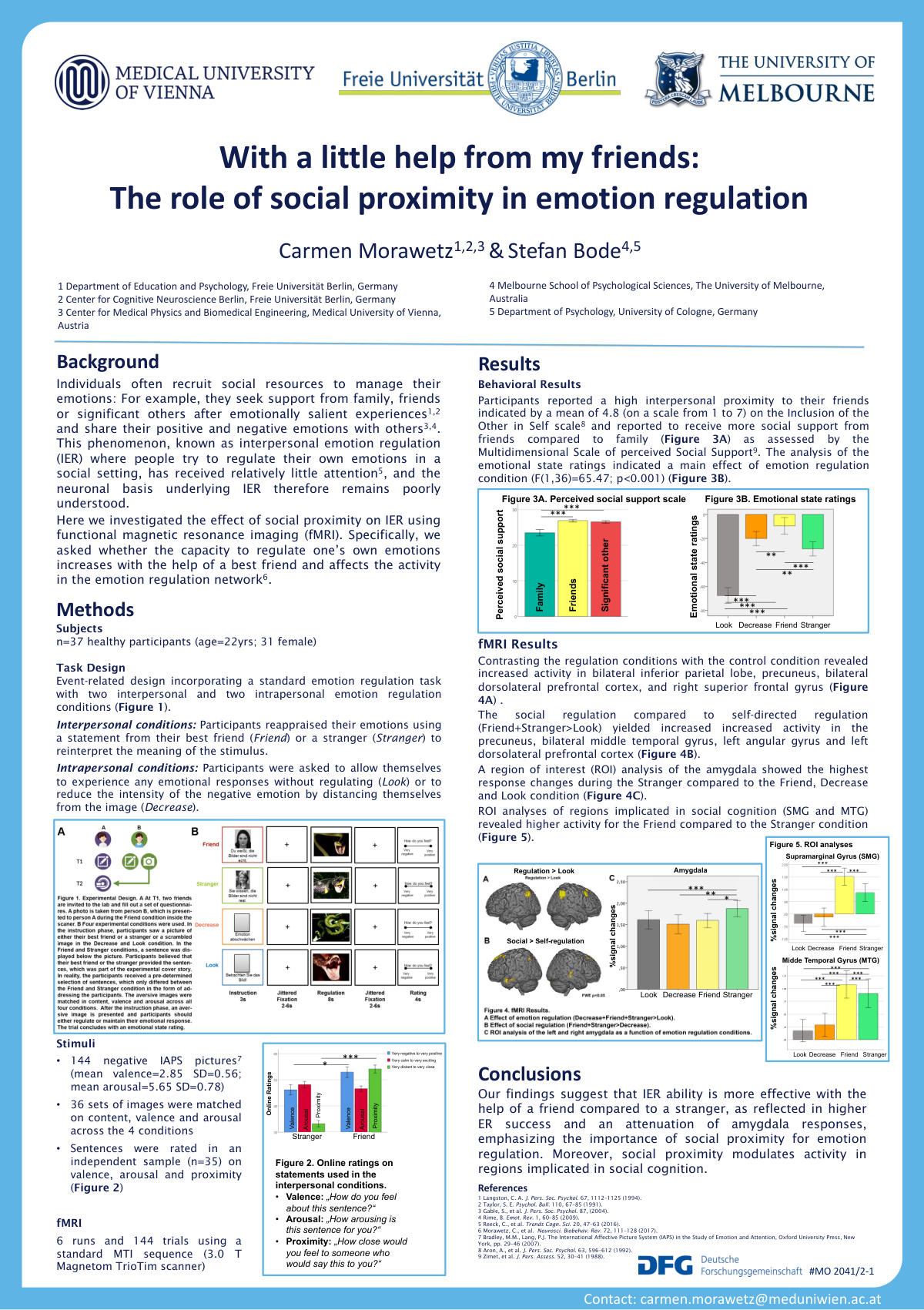
Background In the past, cognitive neuroscience research on emotion regulation (ER) has mainly focused on intrapersonal aspects. However, in emotional situations individuals seek support from others to regulate their emotions. In this study, we used functional MRI to investigate the effect of social proximity on emotion regulation. Methods 37 participants (31 female, age: M=22yrs) performed a standard ER task using reappraisal to down-regulate emotions in response to aversive pictures. We implemented two interpersonal ER conditions (reappraisal with the help of the best Friend or a Stranger), an intrapersonal ER condition (self-directed reappraisal) and a control condition (no reappraisal). Two task-phases were implemented: (1) Instruction phase to reappraise by using a sentence attributed to the other person, or by using an individual strategy; (2) Regulation phase during which an aversive stimulus was presented. This was followed by an emotional state rating. Participants completed 6 runs with 24 trials. Results A main effect of ER condition was observed (F(1,36)=65.47; p<0.001). Participants felt significantly less negative during the Friend compared to Stranger condition (t(36)=-4.98; p<0.001). This effect was associated with decreased amygdala activity in the Friend compared to the Stranger condition. Conclusions Our findings suggest that ER ability is more effective with the help of a friend, as reflected in higher ER success and an attenuation of amygdala responses, emphasizing the importance of social proximity for emotion regulation.
Conference Information
Society for Affective Science
Identifiers
Funding Information
Authors
Carmen Morawetz
Medical University of Vienna
Stefan Bode
The University of Melbourne