Description
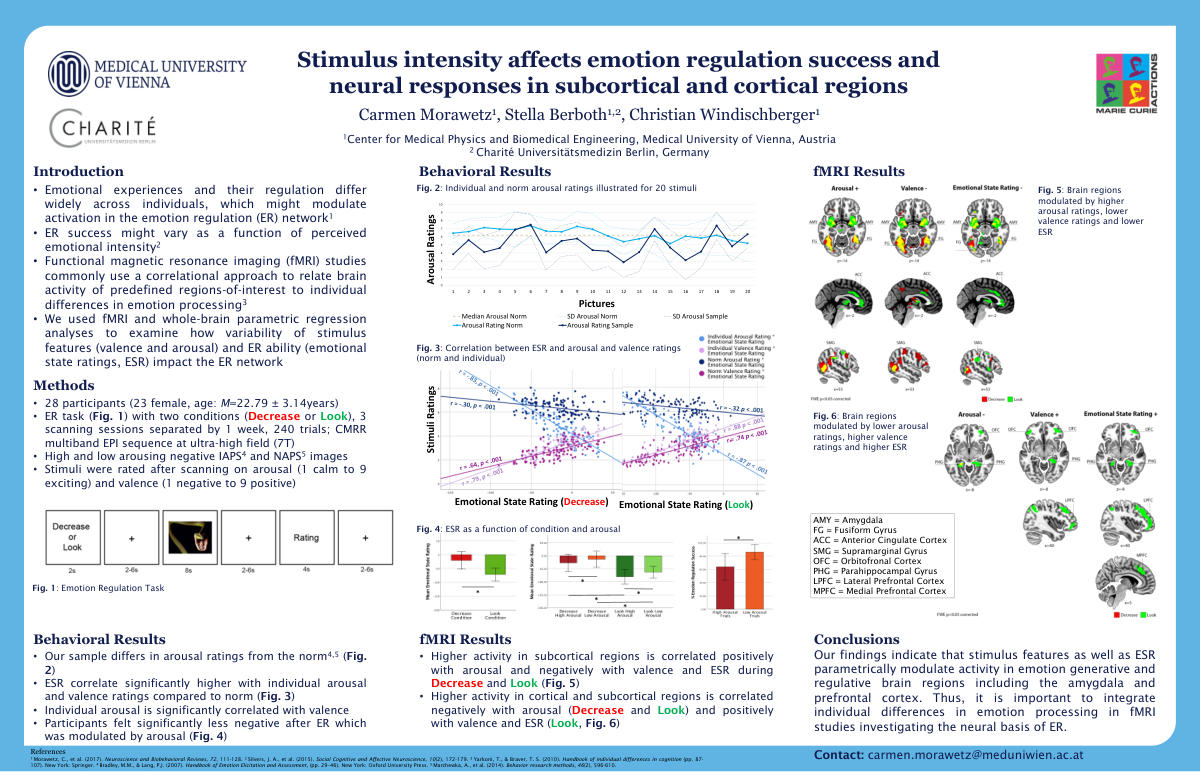
Introduction Individuals differ widely in their experience of emotions and the ability to regulate them. These individual differences might vary as a function of perceived stimulus intensity. Yet, few studies to date have examined how variability in stimulus intensity (SI) impacts emotion regulation (ER) ability and the underlying neural networks. To address this issue, we used a standard fMRI ER task and parametric analyses on a trial-by-trial basis. Methods 20 participants (16f, age: M=22.8±3.3yrs) performed a well-established ER task (see Fig. 1A) during three scanning sessions separated by one week. We acquired four runs/session and 80 trials/session using the CMRR multiband EPI sequence (TR=1.4s; TE=23ms; 78 slices; voxel size=1.5x1.5x1.2mm3) at ultra-high field (7T). 240 aversive images were rated on SI (1 calm to 9 exciting) covering a wide range of arousal (low: 1.69-4.94, M=3.82±0.79; high: 5.06-8.19, M=6.20±0.83). Parametric analyses using emotional state rating (ESR) and SI were performed on the whole sample and a subsample of 14 participants (11f, age: M=22.9±3.8yrs), respectively. Results Participants felt significantly less negative during Decrease compared to Look (t(19)=6.37, p<.001) and that ER success was higher for low compared to high arousing images (t(13)=-5.76, p<0.001). Parametric analysis revealed that responses in the amygdala were positively associated with SI and negatively with ESR independent of the ER condition (Fig. 1B & 1C). Activity in right IPL and dACC was positively correlated with SI and negatively with ESR during Look. This suggests that when participants successfully resist to regulate their emotions, regions implicated in conflict monitoring demonstrate enhanced activity with increasing arousal. Activity in the right DLPFC was negatively modulated by ESR during Decrease, indicating that this region is only affected by ER success. Conclusion These findings indicate that SI affects ER ability and predicts neural responses in regions important for encoding the arousal value of a stimulus as well as conflict monitoring and attention.
Conference Information
Neuroscience
Identifiers
Funding Information
Authors
Carmen Morawetz
Medical University of Vienna
Stella Berboth
Charité - Universitätsmedizin Berlin
Christian Windischberger
Medical University of Vienna