Description
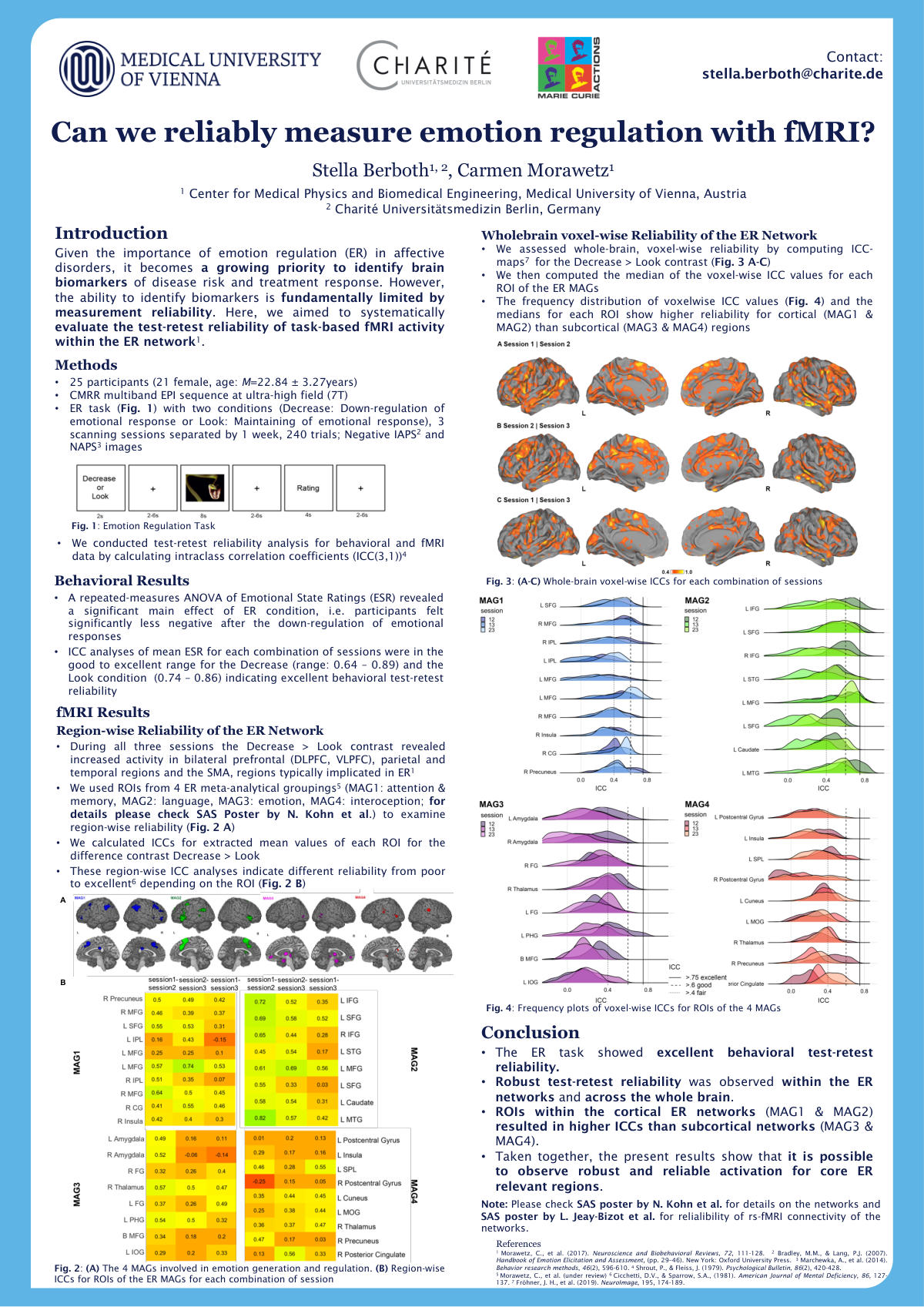
Background Given the importance of emotion regulation (ER) in affective disorders, it becomes a growing priority to identify brain biomarkers of disease risk and treatment response. However, the ability to identify biomarkers is fundamentally limited by measurement reliability. Here, we aimed to systematically evaluate the test-retest reliability of task-based fMRI activity within the ER network. Methods 25 healthy participants (21f, mean age = 22.8 ± 3.3) performed a well-established ER during three scanning sessions separated by one week. We acquired four runs/session and 80 trials/session using the CMRR multiband EPI sequence (TR=1.4s; TE=23ms; 78 slices; voxel size=1.5x1.5x1.2mm3) at ultra-high field (7 Tesla). We conducted region-wise and whole-brain, voxel-wise reliability analyses by computing Intercorrelation Coefficients (ICCs) for previously defined Regions of Interest (ROIs) that are implicated in 4 ER networks (N1: attention & memory, N2: language, N3: emotion, N4: interoception) (Morawetz et al., under review) and whole-brain ICC-maps. Results The ER task showed excellent group level reliability and robust between-subject reliability for region-wise and voxel-wise analyses. Reliability was dependent on the respective ROI and ER networks with cortical regions (N1 & N2) resulting in higher ICCs than subcortical regions (N3 & N4). Conclusions The present results show that it is possible to observe robust and reliable activation for regions implied in ER Neworks which might represent promising candidate biomarkers.
Conference Information
Identifiers
Funding Information
Authors
Stella Berboth
Charité - Universitätsmedizin Berlin
Carmen Morawetz
Medical University of Vienna