Description
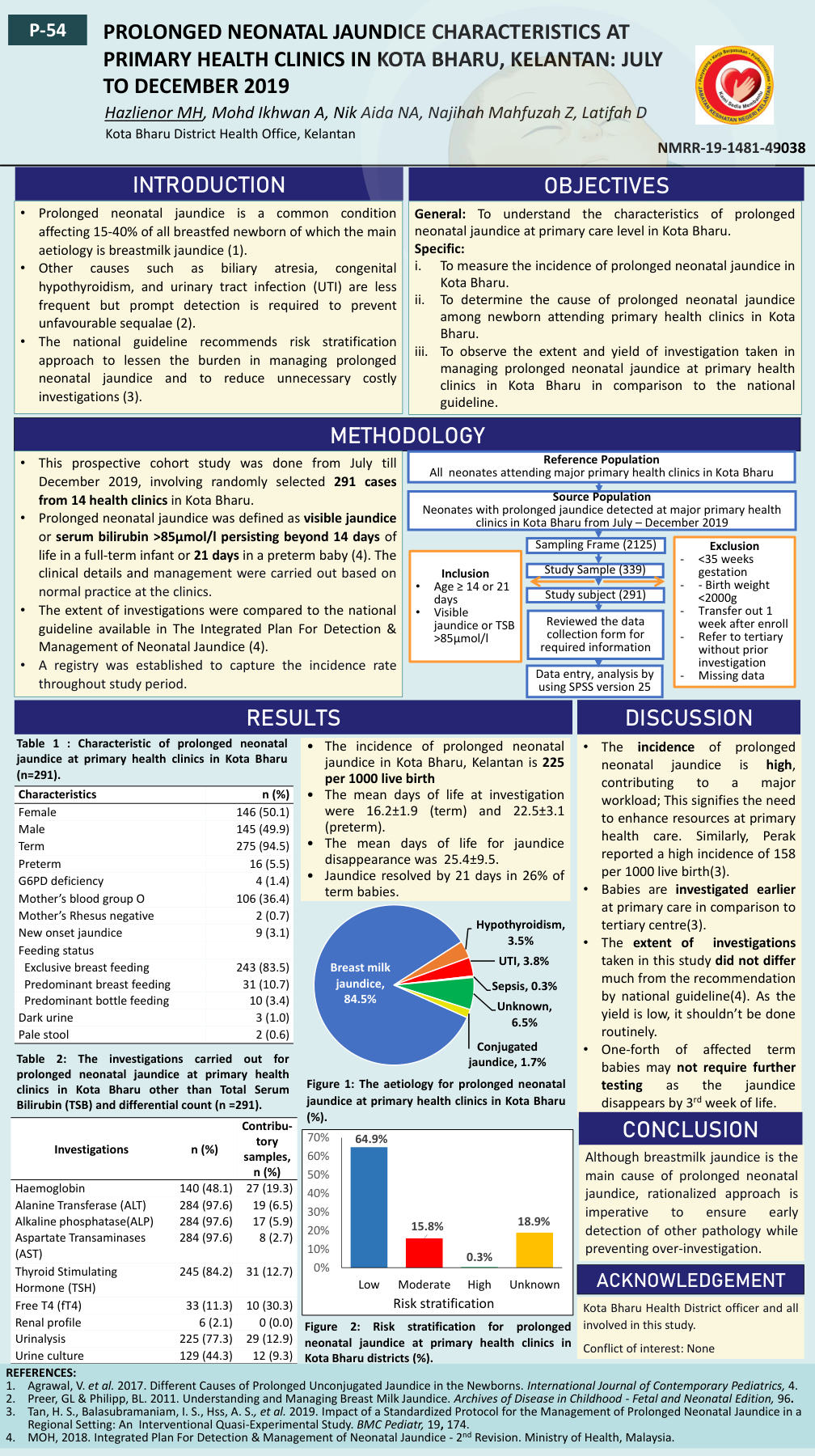
Introduction Prolonged neonatal jaundice is a common condition affecting 15-40% of all breastfed newborn of which the main aetiology is breastmilk jaundice. Other causes such as biliary atresia, congenital hypothyroidism, and urinary tract infection (UTI) are less frequent but prompt detection is required to prevent unfavourable sequalae. The national guideline recommends risk stratification approach to lessen the burden in managing prolonged neonatal jaundice and to reduce unnecessary costly investigations. Objectives General: To understand the characteristics of prolonged neonatal jaundice at primary care level in Kota Bharu. Specific: i. To measure the incidence of prolonged neonatal jaundice in Kota Bharu. ii. To determine the cause of prolonged neonatal jaundice among newborn attending primary health clinics in Kota Bharu. iii. To observe the extent and yield of investigation taken in managing prolonged neonatal jaundice at primary health clinics in Kota Bharu in comparison to the national guideline. Methodology This prospective cohort study was done from July till December 2019, involving randomly selected 291 cases from 14 health clinics in Kota Bharu. Prolonged neonatal jaundice was defined as visible jaundice or serum bilirubin >85µmol/l persisting beyond 14 days of life in a full-term infant or 21 days in a preterm baby. The clinical details and management were carried out based on normal practice at the clinics. The extent of investigations were compared to the national guideline available in The Integrated Plan For Detection & Management of Neonatal Jaundice. A registry was established to capture the incidence rate throughout study period. Results The incidence of prolonged neonatal jaundice in Kota Bharu, Kelantan is 225 per 1000 live birth. The mean days of life at investigation were 16.2±1.9 (term) and 22.5±3.1 (preterm). • The mean days of life for jaundice disappearance was 25.4±9.5. Jaundice resolved by 21 days in 26% of term babies. Discussion The incidence of prolonged neonatal jaundice is high, contributing to a major workload; This signifies the need to enhance resources at primary health care. Similarly, Perak reported a high incidence of 158 per 1000 live birth. Babies are investigated earlier at primary care in comparison to tertiary centre, The extent of investigations taken in this study did not differ much from the recommendation by national guideline. As the yield is low, it shouldn’t be done routinely. One-forth of affected term babies may not require further testing as the jaundice disappears by 3rd week of life. Conclusion Although breastmilk jaundice is the main cause of prolonged neonatal jaundice, rationalized approach is imperative to ensure early detection of other pathology while preventing over-investigation.Hazlienor MH
Conference Information
NMRR-19-1481-49038
Identifiers
Authors
Hazlienor MH
Kota Bharu District Health Office, Kelantan
Mohd Ikhwan A
Kota Bharu District Health Office, Kelantan
Nik Aida NA
Kota Bharu District Health Office, Kelantan
Najihah Mahfuzah Z
Kota Bharu District Health Office, Kelantan
Latifah D
Kota Bharu District Health Office, Kelantan