Description
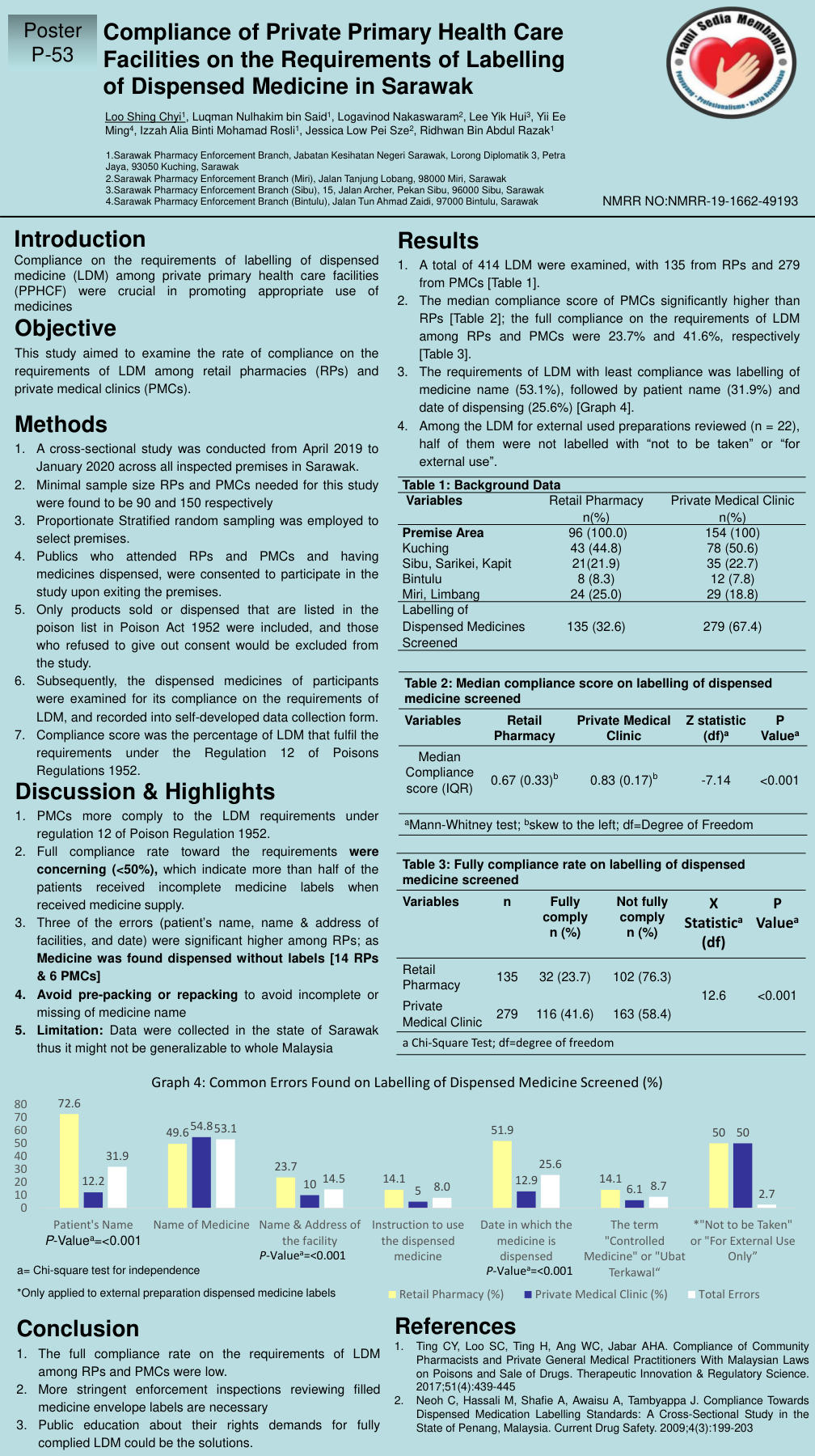
Introduction Compliance on the requirements of labelling of dispensed medicine (LDM) among private primary health care facilities (PPHCF) were crucial in promoting appropriate use of medicines Objective This study aimed to examine the rate of compliance on the requirements of LDM among retail pharmacies (RPs) and private medical clinics (PMCs). Methods A cross-sectional study was conducted from April 2019 to January 2020 across all inspected premises in Sarawak. Minimal sample size RPs and PMCs needed for this study were found to be 90 and 150 respectively Proportionate Stratified random sampling was employed to select premises. Publics who attended RPs and PMCs and having medicines dispensed, were consented to participate in the study upon exiting the premises. Only products sold or dispensed that are listed in the poison list in Poison Act 1952 were included, and those who refused to give out consent would be excluded from the study. Subsequently, the dispensed medicines of participants were examined for its compliance on the requirements of LDM, and recorded into self-developed data collection form. Compliance score was the percentage of LDM that fulfil the requirements under the Regulation 12 of Poisons Regulations 1952. Results A total of 414 LDM were examined, with 135 from RPs and 279 from PMCs [Table 1]. The median compliance score of PMCs significantly higher than RPs [Table 2]; the full compliance on the requirements of LDM among RPs and PMCs were 23.7% and 41.6%, respectively [Table 3]. The requirements of LDM with least compliance was labelling of medicine name (53.1%), followed by patient name (31.9%) and date of dispensing (25.6%) [Graph 4]. Among the LDM for external used preparations reviewed (n = 22), half of them were not labelled with “not to be taken” or “for external use”. Conclusion The full compliance rate on the requirements of LDM among RPs and PMCs were low. 2. More stringent enforcement inspections reviewing filled medicine envelope labels are necessary 3. Public education about their rights demands for fully complied LDM could be the solutions.
Conference Information
Poster P-53
Identifiers
Authors
Loo Shing Chyi
Sarawak Pharmacy Enforcement Branch, Jabatan Kesihatan Negeri Sarawak, Lorong Diplomatik 3, Petra Jaya, 93050 Kuching, Sarawak
ORCID: https://orcid.org/0000-0002-0650-7203
Luqman Nulhakim bin Said
Sarawak Pharmacy Enforcement Branch, Jabatan Kesihatan Negeri Sarawak, Lorong Diplomatik 3, Petra Jaya, 93050 Kuching, Sarawak
Logavinod Nakaswaram
Sarawak Pharmacy Enforcement Branch (Miri), Jalan Tanjung Lobang, 98000 Miri, Sarawak
Lee Yik Hui
Sarawak Pharmacy Enforcement Branch (Sibu), 15, Jalan Archer, Pekan Sibu, 96000 Sibu, Sarawak
Yii Ee Ming
Sarawak Pharmacy Enforcement Branch (Bintulu), Jalan Tun Ahmad Zaidi, 97000 Bintulu, Sarawak
Izzah Alia Binti Mohamad Rosli
Sarawak Pharmacy Enforcement Branch, Jabatan Kesihatan Negeri Sarawak, Lorong Diplomatik 3, Petra Jaya, 93050 Kuching, Sarawak
Jessica Low Pei Sze
Sarawak Pharmacy Enforcement Branch (Miri), Jalan Tanjung Lobang, 98000 Miri, Sarawak
Ridhwan Bin Abdul Razak
Sarawak Pharmacy Enforcement Branch, Jabatan Kesihatan Negeri Sarawak, Lorong Diplomatik 3, Petra Jaya, 93050 Kuching, Sarawak