Description
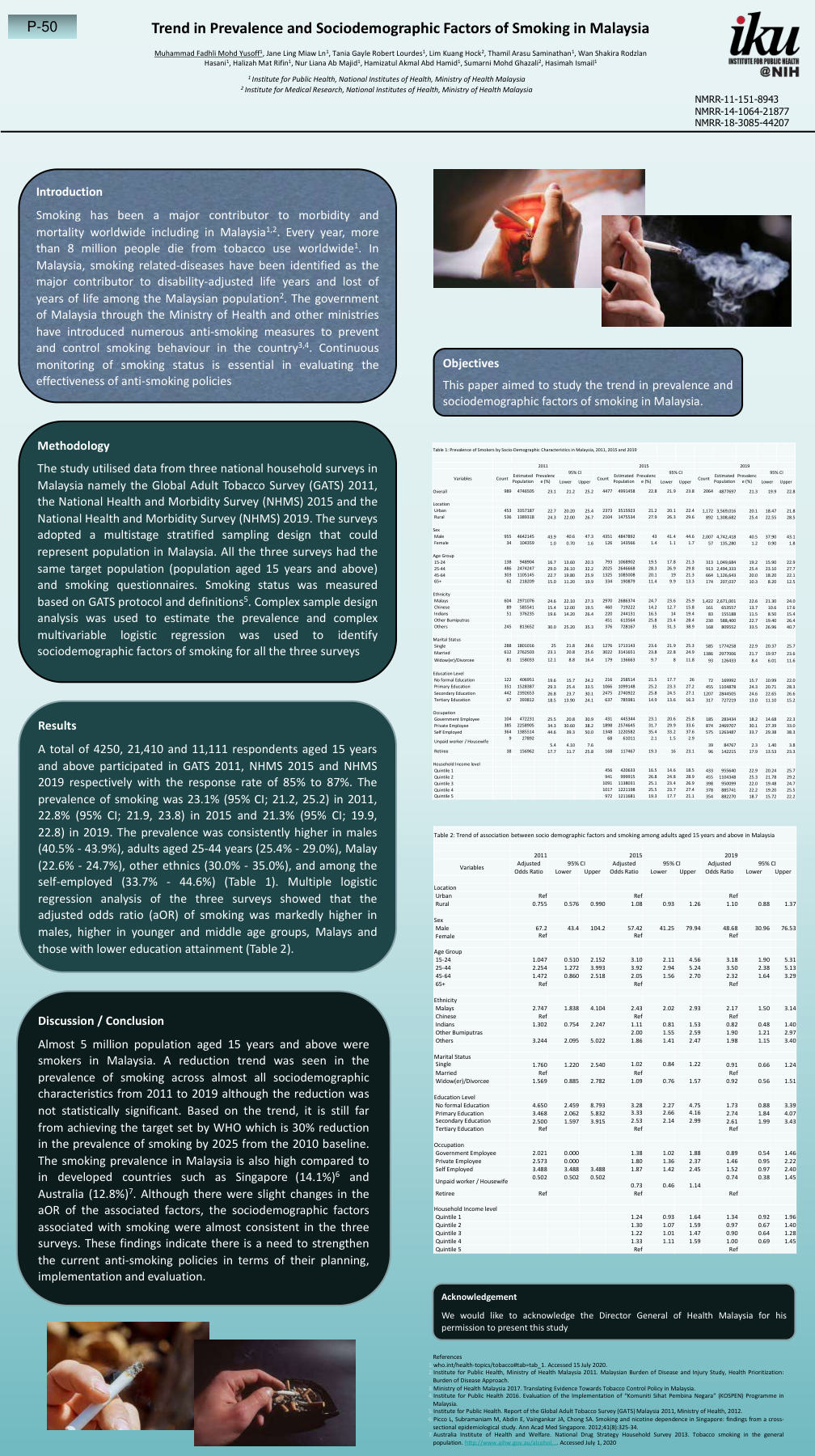
Introduction Smoking has been a major contributor to morbidity and mortality worldwide including in Malaysia. Every year, more than 8 million people die from tobacco use worldwide1 . In Malaysia, smoking related-diseases have been identified as the major contributor to disability-adjusted life years and lost of years of life among the Malaysian population. The government of Malaysia through the Ministry of Health and other ministries have introduced numerous anti-smoking measures to prevent and control smoking behaviour in the country. Continuous monitoring of smoking status is essential in evaluating the effectiveness of anti-smoking policies. Objectives This paper aimed to study the trend in prevalence and sociodemographic factors of smoking in Malaysia. Methodology The study utilised data from three national household surveys in Malaysia namely the Global Adult Tobacco Survey (GATS) 2011, the National Health and Morbidity Survey (NHMS) 2015 and the National Health and Morbidity Survey (NHMS) 2019. The surveys adopted a multistage stratified sampling design that could represent population in Malaysia. All the three surveys had the same target population (population aged 15 years and above) and smoking questionnaires. Smoking status was measured based on GATS protocol and definitions5 . Complex sample design analysis was used to estimate the prevalence and complex multivariable logistic regression was used to identify sociodemographic factors of smoking for all the three surveys. Results A total of 4250, 21,410 and 11,111 respondents aged 15 years and above participated in GATS 2011, NHMS 2015 and NHMS 2019 respectively with the response rate of 85% to 87%. The prevalence of smoking was 23.1% (95% CI; 21.2, 25.2) in 2011, 22.8% (95% CI; 21.9, 23.8) in 2015 and 21.3% (95% CI; 19.9, 22.8) in 2019. The prevalence was consistently higher in males (40.5% - 43.9%), adults aged 25-44 years (25.4% - 29.0%), Malay (22.6% - 24.7%), other ethnics (30.0% - 35.0%), and among the self-employed (33.7% - 44.6%) (Table 1). Multiple logistic regression analysis of the three surveys showed that the adjusted odds ratio (aOR) of smoking was markedly higher in males, higher in younger and middle age groups, Malays and those with lower education attainment (Table 2). Discussion / Conclusion Almost 5 million population aged 15 years and above were smokers in Malaysia. A reduction trend was seen in the prevalence of smoking across almost all sociodemographic characteristics from 2011 to 2019 although the reduction was not statistically significant. Based on the trend, it is still far from achieving the target set by WHO which is 30% reduction in the prevalence of smoking by 2025 from the 2010 baseline. The smoking prevalence in Malaysia is also high compared to in developed countries such as Singapore (14.1%) 6 and Australia (12.8%) 7 . Although there were slight changes in the aOR of the associated factors, the sociodemographic factors associated with smoking were almost consistent in the three surveys. These findings indicate there is a need to strengthen the current anti-smoking policies in terms of their planning, implementation and evaluation.
Identifiers
Authors
Muhammad Fadhli Mohd Yusoff
Institute for Public Health, National Institutes of Health, Ministry of Health Malaysia, Shah Alam, Selangor, Malaysia
ORCID: https://orcid.org/0000-0002-3962-5847
Jane Ling Miaw Ln
Institute for Public Health, National Institutes of Health, Ministry of Health Malaysia, Shah Alam, Selangor, Malaysia
ORCID: https://orcid.org/0000-0003-2044-4015
Tania Gayle Robert Lourdes
Institute for Public Health, National Institutes of Health, Ministry of Health Malaysia, Shah Alam, Selangor, Malaysia
ORCID: https://orcid.org/0000-0002-0313-2821
Lim Kuang Hock
Institute for Medical Research, National Institutes of Health, Ministry of Health Malaysia
ORCID: https://orcid.org/0000-0001-9364-2536
Thamil Arasu Saminathan
Institute for Public Health, National Institutes of Health, Ministry of Health Malaysia, Shah Alam, Selangor, Malaysia
Wan Shakira Rodzlan Hasani
Institute for Public Health, National Institutes of Health, Ministry of Health Malaysia, Shah Alam, Selangor, Malaysia
Halizah Mat Rifin
Institute for Public Health, National Institutes of Health, Ministry of Health Malaysia, Shah Alam, Selangor, Malaysia
Nur Liana Ab Majid
Institute for Public Health, National Institutes of Health, Ministry of Health Malaysia, Shah Alam, Selangor, Malaysia
Hamizatul Akmal Abd Hamid
Institute for Public Health, National Institutes of Health, Ministry of Health Malaysia, Shah Alam, Selangor, Malaysia
Sumarni Mohd Ghazali
Institute for Public Health, National Institutes of Health, Ministry of Health Malaysia, Shah Alam, Selangor, Malaysia
Hasimah Ismail
Institute for Public Health, National Institutes of Health, Ministry of Health Malaysia, Shah Alam, Selangor, Malaysia