Description
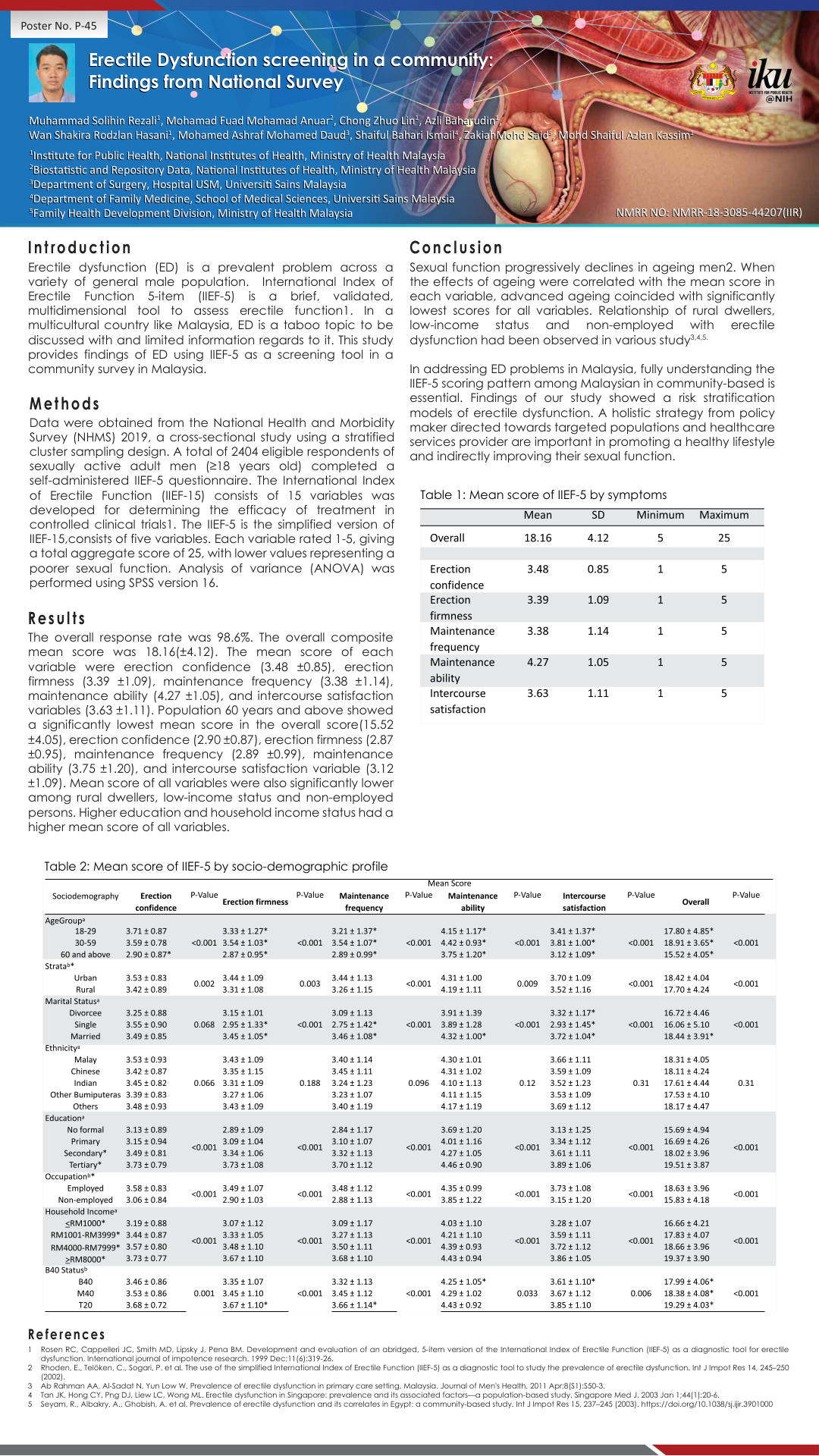
Introduction Erectile dysfunction (ED) is a prevalent problem across a variety of general male population. International Index of Erectile Function 5-item (IIEF-5) is a brief, validated, multidimensional tool to assess erectile function1. In a multicultural country like Malaysia, ED is a taboo topic to be discussed with and limited information regards to it. This study provides findings of ED using IIEF-5 as a screening tool in a community survey in Malaysia. Methods Data were obtained from the National Health and Morbidity Survey (NHMS) 2019, a cross-sectional study using a stratified cluster sampling design. A total of 2404 eligible respondents of sexually active adult men (≥18 years old) completed a self-administered IIEF-5 questionnaire. The International Index of Erectile Function (IIEF-15) consists of 15 variables was developed for determining the efficacy of treatment in controlled clinical trials1. The IIEF‐5 is the simplified version of IIEF-15,consists of five variables. Each variable rated 1-5, giving a total aggregate score of 25, with lower values representing a poorer sexual function. Analysis of variance (ANOVA) was performed using SPSS version 16. Results The overall response rate was 98.6%. The overall composite mean score was 18.16(±4.12). The mean score of each variable were erection confidence (3.48 ±0.85), erection firmness (3.39 ±1.09), maintenance frequency (3.38 ±1.14), maintenance ability (4.27 ±1.05), and intercourse satisfaction variables (3.63 ±1.11). Population 60 years and above showed a significantly lowest mean score in the overall score(15.52 ±4.05), erection confidence (2.90 ±0.87), erection firmness (2.87 ±0.95), maintenance frequency (2.89 ±0.99), maintenance ability (3.75 ±1.20), and intercourse satisfaction variable (3.12 ±1.09). Mean score of all variables were also significantly lower among rural dwellers, low-income status and non-employed persons. Higher education and household income status had a higher mean score of all variables. Conclusion Sexual function progressively declines in ageing men2. When the effects of ageing were correlated with the mean score in each variable, advanced ageing coincided with significantly lowest scores for all variables. Relationship of rural dwellers, low-income status and non-employed with erectile dysfunction had been observed in various study3,4,5. In addressing ED problems in Malaysia, fully understanding the IIEF-5 scoring pattern among Malaysian in community-based is essential. Findings of our study showed a risk stratification models of erectile dysfunction. A holistic strategy from policy maker directed towards targeted populations and healthcare services provider are important in promoting a healthy lifestyle and indirectly improving their sexual function.
Conference Information
National Survey
Identifiers
Authors
Muhammad Solihin Rezali
Institute for Public Health, National Institutes of Health, Ministry of Health Malaysia, Shah Alam, Selangor, Malaysia
Mohamad Fuad Mohamad Anuar
Biostatistic and Repository Data, National Institutes of Health, Ministry of Health Malaysia
Chong Zhuo Lin
Institute for Public Health, National Institutes of Health, Ministry of Health Malaysia, Shah Alam, Selangor, Malaysia
Azli Baharudin
Institute for Public Health, National Institutes of Health, Ministry of Health Malaysia, Shah Alam, Selangor, Malaysia
Wan Shakira Rodzlan Hasani
Institute for Public Health, National Institutes of Health, Ministry of Health Malaysia, Shah Alam, Selangor, Malaysia
Mohamed Ashraf Mohamed Daud
Department of Surgery, Hospital USM, Universiti Sains Malaysia
Shaiful Bahari Ismail
Department of Family Medicine, School of Medical Sciences, Universiti Sains Malaysia
Zakiah Mohd Said
Family Health Development Division, Ministry of Health Malaysia
Mohd Shaiful Azlan Kassim
Institute for Public Health, National Institutes of Health, Ministry of Health Malaysia, Shah Alam, Selangor, Malaysia
ZakiahMohd Said
Family Health Development Division, Ministry of Health Malaysia