Exploring Cluster Hospital Implementation Process Using Consolidated Framework for Implementation Research (CFIR)
Description
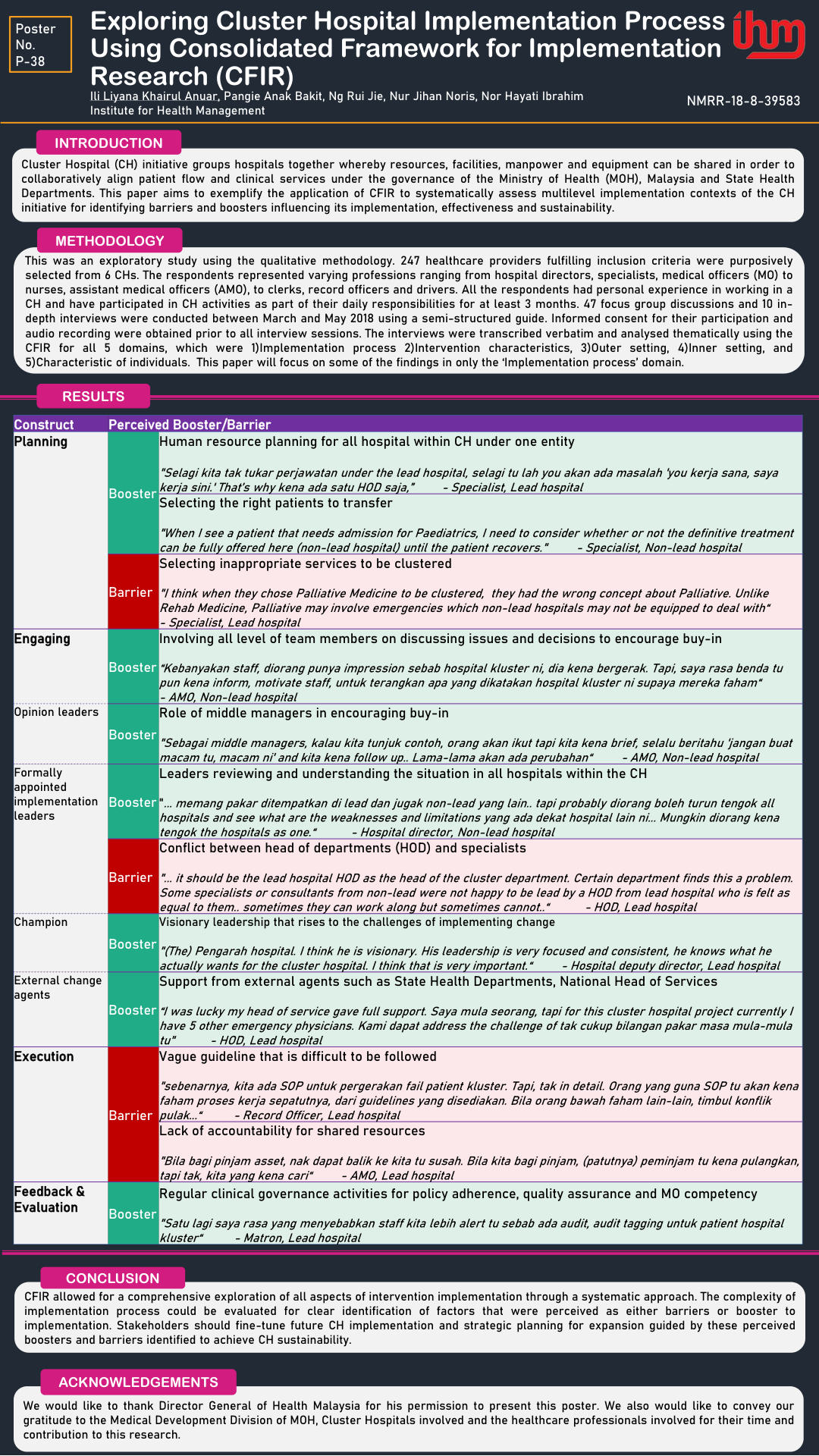
Introduction Cluster Hospital (CH) initiative groups hospitals together whereby resources, facilities, manpower and equipment can be shared in order to collaboratively align patient flow and clinical services under the governance of the Ministry of Health (MOH), Malaysia and State Health Departments. This paper aims to exemplify the application of CFIR to systematically assess multilevel implementation contexts of the CH initiative for identifying barriers and boosters influencing its implementation, effectiveness and sustainability. Methodology This was an exploratory study using the qualitative methodology. 247 healthcare providers fulfilling inclusion criteria were purposively selected from 6 CHs. The respondents represented varying professions ranging from hospital directors, specialists, medical officers (MO) to nurses, assistant medical officers (AMO), to clerks, record officers and drivers. All the respondents had personal experience in working in a CH and have participated in CH activities as part of their daily responsibilities for at least 3 months. 47 focus group discussions and 10 indepth interviews were conducted between March and May 2018 using a semi-structured guide. Informed consent for their participation and audio recording were obtained prior to all interview sessions. The interviews were transcribed verbatim and analysed thematically using the CFIR for all 5 domains, which were 1)Implementation process 2)Intervention characteristics, 3)Outer setting, 4)Inner setting, and 5)Characteristic of individuals. This paper will focus on some of the findings in only the ‘Implementation process’ domain. Results [Refer to Poster]. Conclusion CFIR allowed for a comprehensive exploration of all aspects of intervention implementation through a systematic approach. The complexity of implementation process could be evaluated for clear identification of factors that were perceived as either barriers or booster to implementation. Stakeholders should fine-tune future CH implementation and strategic planning for expansion guided by these perceived boosters and barriers identified to achieve CH sustainability.
Identifiers
Authors
Ili Liyana Khairul Anuar
Institute for Health Management, National Institutes of Health
Pangie Anak Bakit
Institute for Health Management
Ng Rui Jie
Institute for Health Management
Nur Jihan Horis
Institute for Health Management, National Institutes of Health
Nor Hayati Ibrahim
Institute for Health Management