Description
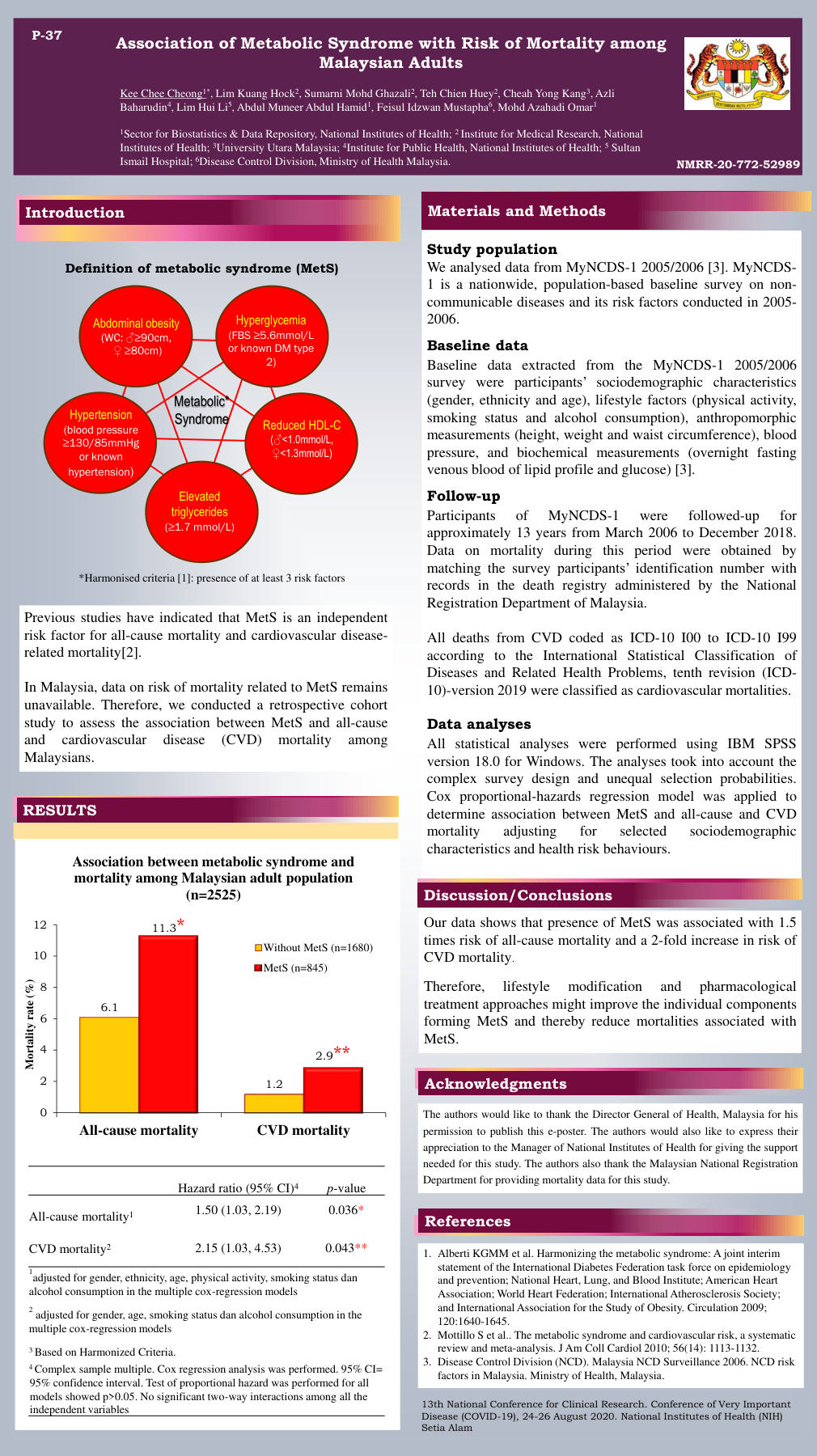
Introduction Previous studies have indicated that MetS is an independent risk factor for all-cause mortality and cardiovascular diseaserelated mortality. In Malaysia, data on risk of mortality related to MetS remains unavailable. Therefore, we conducted a retrospective cohort study to assess the association between MetS and all-cause and cardiovascular disease (CVD) mortality among Malaysians. Materials and Methods Study population We analysed data from MyNCDS-1 2005/2006. MyNCDS1 is a nationwide, population-based baseline survey on noncommunicable diseases and its risk factors conducted in 2005- 2006. Baseline data Baseline data extracted from the MyNCDS-1 2005/2006 survey were participants’ sociodemographic characteristics (gender, ethnicity and age), lifestyle factors (physical activity, smoking status and alcohol consumption), anthropomorphic measurements (height, weight and waist circumference), blood pressure, and biochemical measurements (overnight fasting venous blood of lipid profile and glucose). Follow-up Participants of MyNCDS-1 were followed-up for approximately 13 years from March 2006 to December 2018. Data on mortality during this period were obtained by matching the survey participants’ identification number with records in the death registry administered by the National Registration Department of Malaysia. All deaths from CVD coded as ICD-10 I00 to ICD-10 I99 according to the International Statistical Classification of Diseases and Related Health Problems, tenth revision (ICD10)-version 2019 were classified as cardiovascular mortalities. Data analyses All statistical analyses were performed using IBM SPSS version 18.0 for Windows. The analyses took into account the complex survey design and unequal selection probabilities. Cox proportional-hazards regression model was applied to determine association between MetS and all-cause and CVD mortality adjusting for selected sociodemographic characteristics and health risk behaviours. Results [Refer to Poster]. Discussion / Conclusion Our data shows that presence of MetS was associated with 1.5 times risk of all-cause mortality and a 2-fold increase in risk of CVD mortality. Therefore, lifestyle modification and pharmacological treatment approaches might improve the individual components forming MetS and thereby reduce mortalities associated with MetS.
Conference Information
13th National Conference for Clinical Research. Conference of Very Important Disease (COVID-19)
Identifiers
Authors
Kee Chee Cheong
Sector for Biostatistics & Data Repository, National Institutes of Health
ORCID: https://orcid.org/0000-0003-1372-9549
Lim Kuang Hock
Institute for Medical Research, National Institutes of Health
ORCID: https://orcid.org/0000-0001-9364-2536
Sumarni Mohd Ghazali
Institute for Medical Research, National Institutes of Health
ORCID: https://orcid.org/0000-0002-2312-7851
Teh Chien Huey
Institute for Medical Research, National Institutes of Health
ORCID: https://orcid.org/0000-0001-8978-9965
Cheah Yong Kang
University Utara Malaysia
ORCID: https://orcid.org/0000-0002-6793-7055
Azli Baharudin
Institute for Public Health, National Institutes of Health, Ministry of Health Malaysia, Shah Alam, Selangor, Malaysia
Lim Hui Li
Sultan Ismail Hospital
Abdul Muneer Abdul Hamid
Sector for Biostatistics & Data Repository, National Institutes of Health
Feisul Idzwan Mustapha
Disease Control Division, Ministry of Health Malaysia
ORCID: https://orcid.org/0000-0003-3497-341X
Mohd Azahadi Omar
Sector for Biostatistics & Data Repository, National Institutes of Health