Description
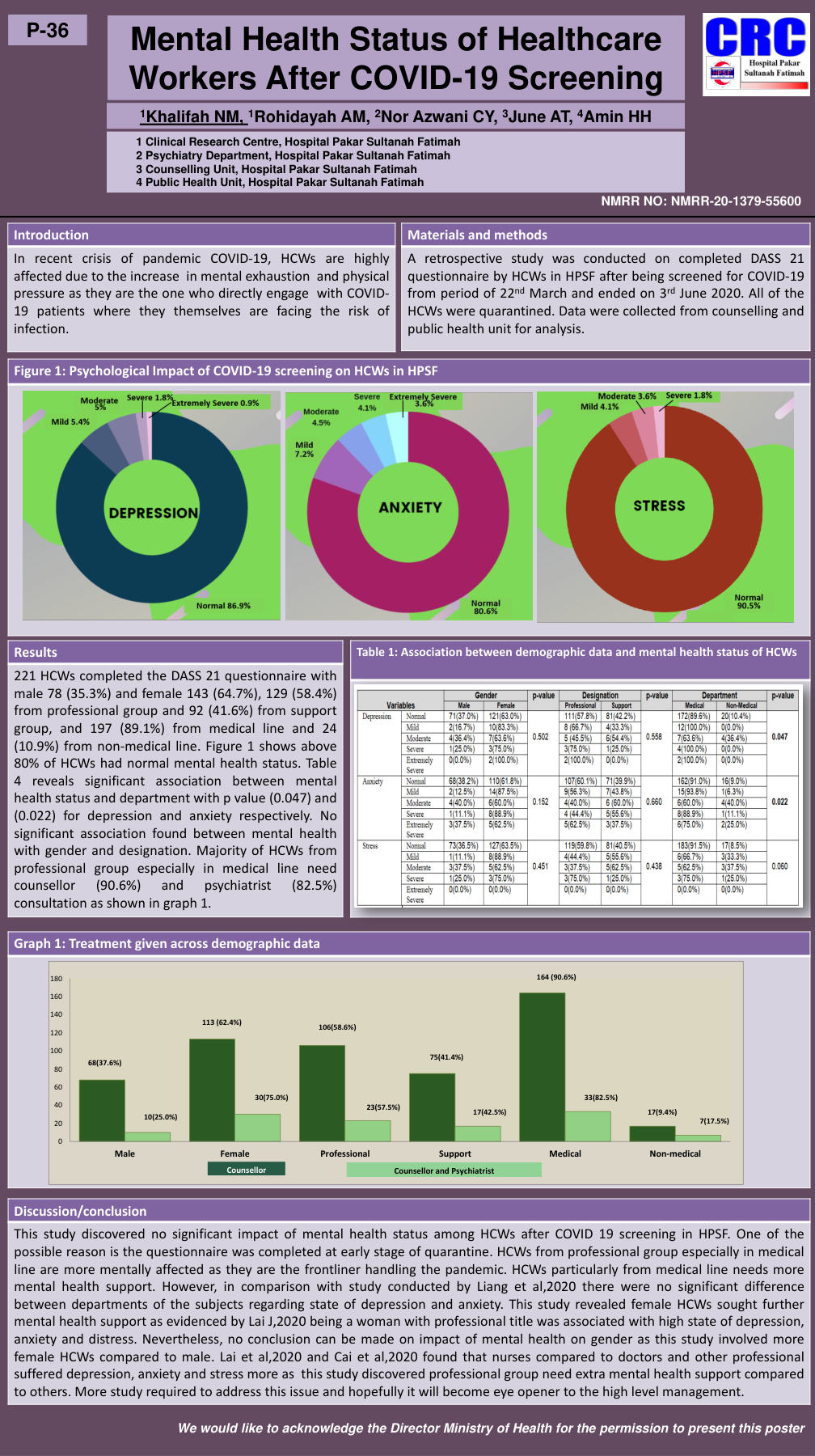
Introduction In recent crisis of pandemic COVID-19, HCWs are highly affected due to the increase in mental exhaustion and physical pressure as they are the one who directly engage with COVID19 patients where they themselves are facing the risk of infection. Materials and Methods A retrospective study was conducted on completed DASS 21 questionnaire by HCWs in HPSF after being screened for COVID-19 from period of 22nd March and ended on 3 rd June 2020. All of the HCWs were quarantined. Data were collected from counselling and public health unit for analysis. Results 221 HCWs completed the DASS 21 questionnaire with male 78 (35.3%) and female 143 (64.7%), 129 (58.4%) from professional group and 92 (41.6%) from support group, and 197 (89.1%) from medical line and 24 (10.9%) from non-medical line. Figure 1 shows above 80% of HCWs had normal mental health status. Table 4 reveals significant association between mental health status and department with p value (0.047) and (0.022) for depression and anxiety respectively. No significant association found between mental health with gender and designation. Majority of HCWs from professional group especially in medical line need counsellor (90.6%) and psychiatrist (82.5%) consultation as shown in graph 1. Discussion / Conclusion This study discovered no significant impact of mental health status among HCWs after COVID 19 screening in HPSF. One of the possible reason is the questionnaire was completed at early stage of quarantine. HCWs from professional group especially in medical line are more mentally affected as they are the frontliner handling the pandemic. HCWs particularly from medical line needs more mental health support. However, in comparison with study conducted by Liang et al,2020 there were no significant difference between departments of the subjects regarding state of depression and anxiety. This study revealed female HCWs sought further mental health support as evidenced by Lai J,2020 being a woman with professional title was associated with high state of depression, anxiety and distress. Nevertheless, no conclusion can be made on impact of mental health on gender as this study involved more female HCWs compared to male. Lai et al,2020 and Cai et al,2020 found that nurses compared to doctors and other professional suffered depression, anxiety and stress more as this study discovered professional group need extra mental health support compared to others. More study required to address this issue and hopefully it will become eye opener to the high level management.
Identifiers
Authors
Khalifah NM
Clinical Research Centre, Hospital Pakar Sultanah Fatimah
Rohidayah AM
Clinical Research Centre, Hospital Pakar Sultanah Fatimah
Nor Azwani CY
Psychiatry Department, Hospital Pakar Sultanah Fatimah
June AT
Counselling Unit, Hospital Pakar Sultanah Fatimah
Amin HH
Public Health Unit, Hospital Pakar Sultanah Fatimah