Description
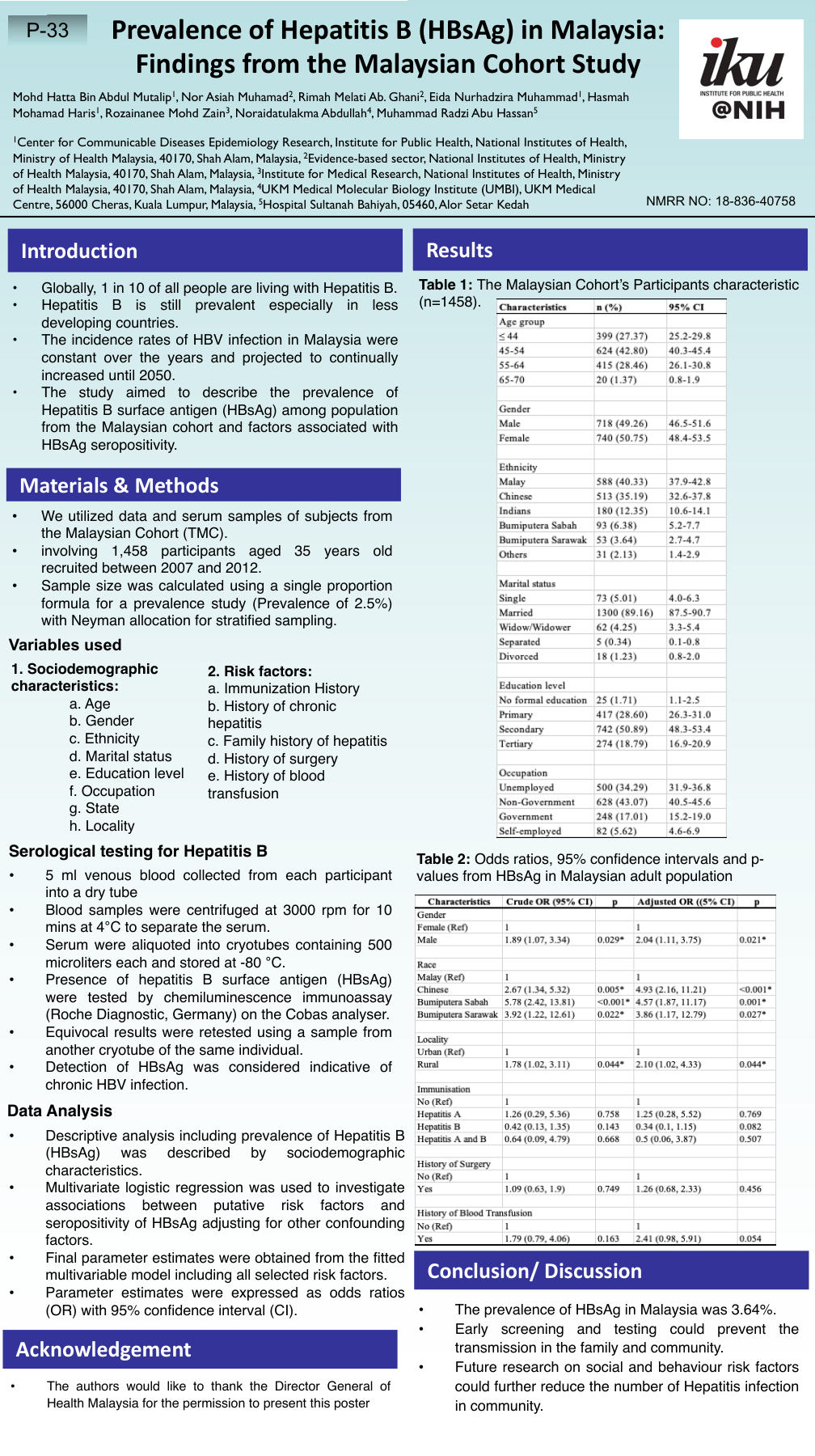
Introduction Globally, 1 in 10 of all people are living with Hepatitis B. Hepatitis B is still prevalent especially in less developing countries. The incidence rates of HBV infection in Malaysia were constant over the years and projected to continually increased until 2050. The study aimed to describe the prevalence of Hepatitis B surface antigen (HBsAg) among population from the Malaysian cohort and factors associated with HBsAg seropositivity. Materials and Methods We utilized data and serum samples of subjects from the Malaysian Cohort (TMC) involving 1,458 participants aged 35 years old recruited between 2007 and 2012. •Sample size was calculated using a single proportion formula for a prevalence study (Prevalence of 2.5%) with Neyman allocation for stratified sampling. Serological testing for Hepatitis B 5 ml venous blood collected from each participant into a dry tube. Blood samples were centrifuged at 3000 rpm for 10 mins at 4°C to separate the serum. Serum were aliquoted into cryotubes containing 500 microliters each and stored at -80 °C. Presence of hepatitis B surface antigen (HBsAg) were tested by chemiluminescence immunoassay (Roche Diagnostic, Germany) on the Cobas analyser. Equivocal results were retested using a sample from another cryotube of the same individual. Detection of HBsAg was considered indicative of chronic HBV infection. Data Analysis Descriptive analysis including prevalence of Hepatitis B (HBsAg) was described by sociodemographic characteristics. Multivariate logistic regression was used to investigate associations between putative risk factors and seropositivity of HBsAg adjusting for other confounding factors. Final parameter estimates were obtained from the fitted multivariable model including all selected risk factors. Parameter estimates were expressed as odds ratios (OR) with 95% confidence interval (CI). Results [Refer to Poster]. Discussion / Conclusion The prevalence of HBsAg in Malaysia was 3.64%. Early screening and testing could prevent the transmission in the family and community. Future research on social and behaviour risk factors could further reduce the number of Hepatitis infection in community.
Identifiers
Authors
Mohd Hatta Bin Abdul Mutalip
Center for Communicable Diseases Epidemiology Research, Institute for Public Health, National Institutes of Health, Ministry of Health Malaysia
ORCID: https://orcid.org/0000-0002-2750-5792
Nor Asiah Muhamad
Evidence-based sector, National Institutes of Health, Ministry of Health Malaysia
Rimah Melati Ab. Ghani
Evidence-based sector, National Institutes of Health, Ministry of Health Malaysia
ORCID: https://orcid.org/0000-0002-7186-0003
Eida Nurhadzira Muhammad
Center for Communicable Diseases Epidemiology Research, Institute for Public Health, National Institutes of Health, Ministry of Health Malaysia
ORCID: https://orcid.org/0000-0001-7061-4698
Hasmah Mohamad Haris
Center for Communicable Diseases Epidemiology Research, Institute for Public Health, National Institutes of Health, Ministry of Health Malaysia
Rozainanee Mohd Zain
Institute for Medical Research, National Institutes of Health, Ministry of Health Malaysia
Noraidatulakma Abdullah
UKM Medical Molecular Biology Institute (UMBI), UKM Medical Centre
Muhammad Radzi Abu Hassan
Hospital Sultanah Bahiyah