Description
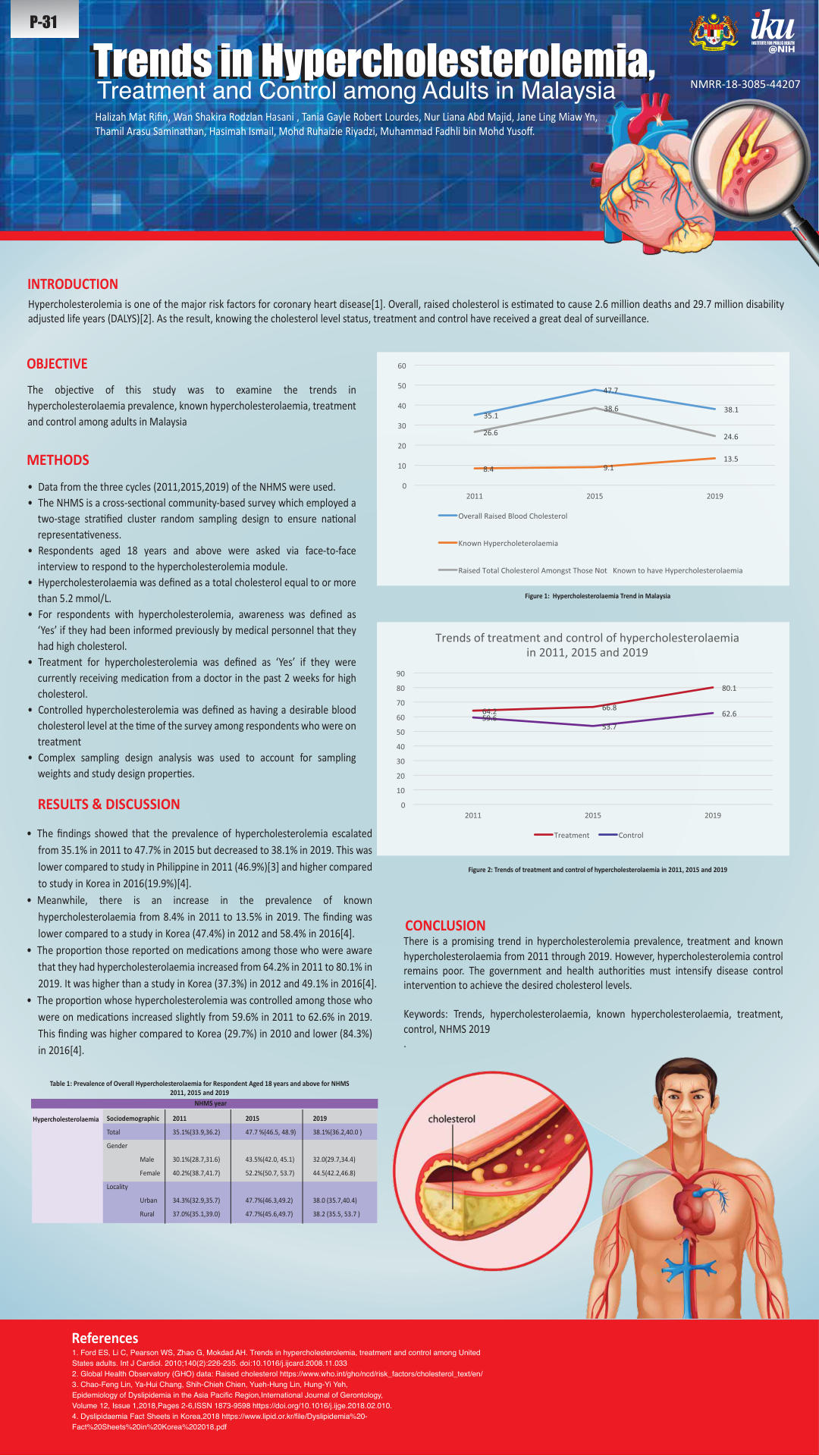
Introduction Hypercholesterolemia is one of the major risk factors for coronary heart disease. Overall, raised cholesterol is estimated to cause 2.6 million deaths and 29.7 million disability adjusted life years (DALYS). As the result, knowing the cholesterol level status, treatment and control have received a great deal of surveillance. Objectives The objective of this study was to examine the trends in hypercholesterolaemia prevalence, known hypercholesterolaemia, treatment and control among adults in Malaysia. Methodology Data from the three cycles (2011,2015,2019) of the NHMS were used. • The NHMS is a cross-sectional community-based survey which employed a two-stage stratified cluster random sampling design to ensure national representativeness. Respondents aged 18 years and above were asked via face-to-face interview to respond to the hypercholesterolemia module. Hypercholesterolaemia was defined as a total cholesterol equal to or more than 5.2 mmol/L. For respondents with hypercholesterolemia, awareness was defined as ‘Yes’ if they had been informed previously by medical personnel that they had high cholesterol. • Treatment for hypercholesterolemia was defined as ‘Yes’ if they were currently receiving medication from a doctor in the past 2 weeks for high cholesterol. • Controlled hypercholesterolemia was defined as having a desirable blood cholesterol level at the time of the survey among respondents who were on treatment • Complex sampling design analysis was used to account for sampling weights and study design properties. Results and Discussion The findings showed that the prevalence of hypercholesterolemia escalated from 35.1% in 2011 to 47.7% in 2015 but decreased to 38.1% in 2019. This was lower compared to study in Philippine in 2011 (46.9%) and higher compared to study in Korea in 2016(19.9%). Meanwhile, there is an increase in the prevalence of known hypercholesterolaemia from 8.4% in 2011 to 13.5% in 2019. The finding was lower compared to a study in Korea (47.4%) in 2012 and 58.4% in 2016. The proportion those reported on medications among those who were aware that they had hypercholesterolaemia increased from 64.2% in 2011 to 80.1% in 2019. It was higher than a study in Korea (37.3%) in 2012 and 49.1% in 2016. The proportion whose hypercholesterolemia was controlled among those who were on medications increased slightly from 59.6% in 2011 to 62.6% in 2019. This finding was higher compared to Korea (29.7%) in 2010 and lower (84.3%) in 2016. Conclusion There is a promising trend in hypercholesterolemia prevalence, treatment and known hypercholesterolaemia from 2011 through 2019. However, hypercholesterolemia control remains poor. The government and health authorities must intensify disease control intervention to achieve the desired cholesterol levels.
Identifiers
Authors
Halizah Mat Rifin
Institute for Public Health, National Institutes of Health, Ministry of Health Malaysia, Shah Alam, Selangor, Malaysia
ORCID: https://orcid.org/0000-0002-5067-5677
Wan Shakira Rodzlan Hasani
Institute for Public Health, National Institutes of Health, Ministry of Health Malaysia, Shah Alam, Selangor, Malaysia
Tania Gayle Robert Lourdes
Institute for Public Health, National Institutes of Health, Ministry of Health Malaysia, Shah Alam, Selangor, Malaysia
Nur Liana Abd Majid
Institute for Public Health, National Institutes of Health, Ministry of Health Malaysia, Shah Alam, Selangor, Malaysia
Jane Ling Miaw Yn
Institute for Public Health, National Institutes of Health, Ministry of Health Malaysia, Shah Alam, Selangor, Malaysia
Thamil Arasu Saminathan
Institute for Public Health, National Institutes of Health, Ministry of Health Malaysia, Shah Alam, Selangor, Malaysia
Hasimah Ismail
Institute for Public Health, National Institutes of Health, Ministry of Health Malaysia, Shah Alam, Selangor, Malaysia
Mohd Ruhaizie Riyadzi
Institute for Public Health, National Institutes of Health, Ministry of Health Malaysia, Shah Alam, Selangor, Malaysia
Muhammad Fadhli bin Mohd Yusof
Institute for Public Health, National Institutes of Health, Ministry of Health Malaysia, Shah Alam, Selangor, Malaysia
Muhammad Fadhli bin Mohd Yusoff
Institute