Description
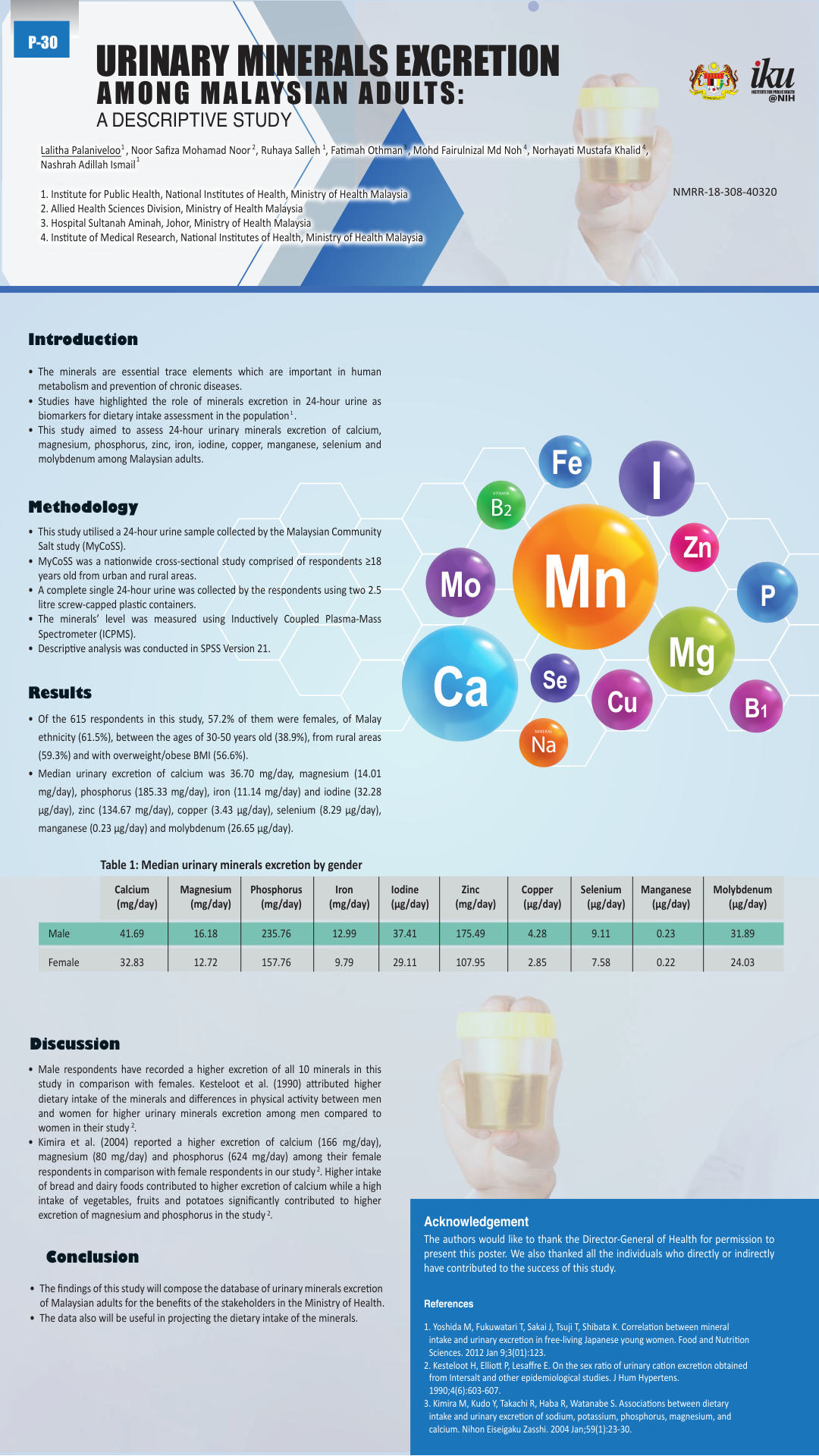
Introduction The minerals are essential trace elements which are important in human metabolism and prevention of chronic diseases. Studies have highlighted the role of minerals excretion in 24-hour urine as biomarkers for dietary intake assessment in the population. This study aimed to assess 24-hour urinary minerals excretion of calcium, magnesium, phosphorus, zinc, iron, iodine, copper, manganese, selenium and molybdenum among Malaysian adults. Methodology This study utilised a 24-hour urine sample collected by the Malaysian Community Salt study (MyCoSS). MyCoSS was a nationwide cross-sectional study comprised of respondents ≥18 years old from urban and rural areas. A complete single 24-hour urine was collected by the respondents using two 2.5 litre screw-capped plastic containers. • The minerals’ level was measured using Inductively Coupled Plasma-Mass Spectrometer (ICPMS). • Descriptive analysis was conducted in SPSS Version 21. Results Of the 615 respondents in this study, 57.2% of them were females, of Malay ethnicity (61.5%), between the ages of 30-50 years old (38.9%), from rural areas (59.3%) and with overweight/obese BMI (56.6%). Median urinary excretion of calcium was 36.70 mg/day, magnesium (14.01 mg/day), phosphorus (185.33 mg/day), iron (11.14 mg/day) and iodine (32.28 µg/day), zinc (134.67 mg/day), copper (3.43 µg/day), selenium (8.29 µg/day), manganese (0.23 µg/day) and molybdenum (26.65 µg/day). Discussion Male respondents have recorded a higher excretion of all 10 minerals in this study in comparison with females. Kesteloot et al. (1990) attributed higher dietary intake of the minerals and differences in physical activity between men and women for higher urinary minerals excretion among men compared to women in their study. Kimira et al. (2004) reported a higher excretion of calcium (166 mg/day), magnesium (80 mg/day) and phosphorus (624 mg/day) among their female respondents in comparison with female respondents in our study . Higher intake of bread and dairy foods contributed to higher excretion of calcium while a high intake of vegetables, fruits and potatoes significantly contributed to higher excretion of magnesium and phosphorus in the study. Conclusion The findings of this study will compose the database of urinary minerals excretion of Malaysian adults for the benefits of the stakeholders in the Ministry of Health. • The data also will be useful in projecting the dietary intake of the minerals.
Conference Information
NMRR-18-308-40320
Identifiers
Authors
Lalitha Palaniveloo
Institute for Public Health, National Institutes of Health, Ministry of Health Malaysia
ORCID: https://orcid.org/0000-0002-0321-4229
Noor Safiza Mohamad Noor
Allied Health Sciences Division, Ministry of Health Malaysia
Ruhaya Salleh
Hospital Sultanah Aminah, Johor, Ministry of Health Malaysia
Mohd Fairulnizal Md Noh
Institute for Medical Research, National Institutes of Health, Ministry of Health Malaysia
Norhayati Mustafa Khalid
Institute for Medical Research, National Institutes of Health, Ministry of Health Malaysia
Nashrah Adillah Ismail
Institute for Public Health, National Institutes of Health, Ministry of Health Malaysia
Fatimah Othman
National Institutes of Health