Description
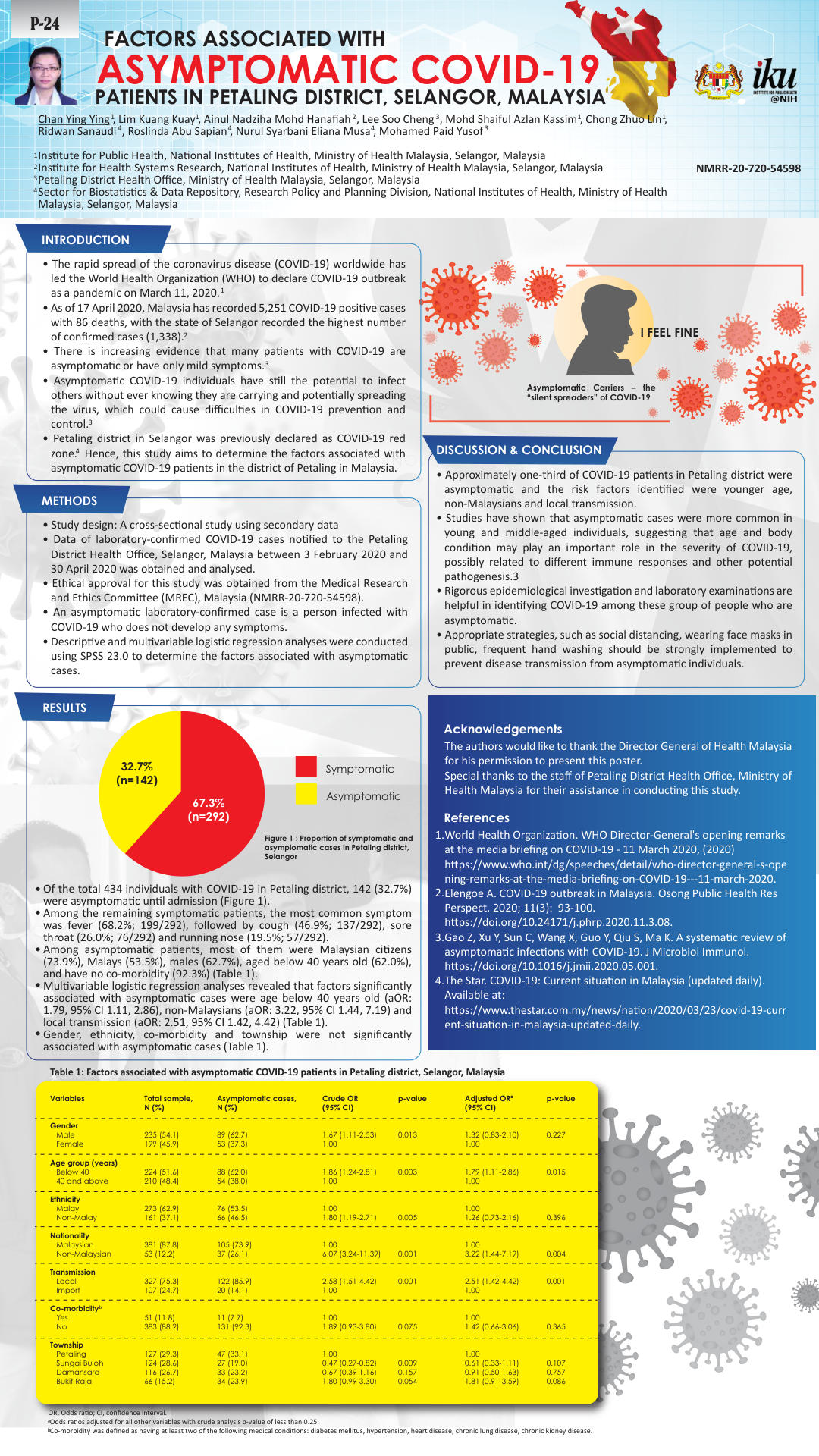
Introduction The rapid spread of the coronavirus disease (COVID-19) worldwide has led the World Health Organization (WHO) to declare COVID-19 outbreak as a pandemic on March 11, 2020. As of 17 April 2020, Malaysia has recorded 5,251 COVID-19 positive cases with 86 deaths, with the state of Selangor recorded the highest number of confirmed cases (1,338). There is increasing evidence that many patients with COVID-19 are asymptomatic or have only mild symptoms. Asymptomatic COVID-19 individuals have still the potential to infect others without ever knowing they are carrying and potentially spreading the virus, which could cause difficulties in COVID-19 prevention and control. Petaling district in Selangor was previously declared as COVID-19 red zone. Hence, this study aims to determine the factors associated with asymptomatic COVID-19 patients in the district of Petaling in Malaysia. Methods Study design: A cross-sectional study using secondary data • Data of laboratory-confirmed COVID-19 cases notified to the Petaling District Health Office, Selangor, Malaysia between 3 February 2020 and 30 April 2020 was obtained and analysed. • Ethical approval for this study was obtained from the Medical Research and Ethics Committee (MREC), Malaysia (NMRR-20-720-54598). • An asymptomatic laboratory-confirmed case is a person infected with COVID-19 who does not develop any symptoms. • Descriptive and multivariable logistic regression analyses were conducted using SPSS 23.0 to determine the factors associated with asymptomatic cases. Results [Refer to Poster]. Discussion / Conclusion Approximately one-third of COVID-19 patients in Petaling district were asymptomatic and the risk factors identified were younger age, non-Malaysians and local transmission. • Studies have shown that asymptomatic cases were more common in young and middle-aged individuals, suggesting that age and body condition may play an important role in the severity of COVID-19, possibly related to different immune responses and other potential pathogenesis.3 • Rigorous epidemiological investigation and laboratory examinations are helpful in identifying COVID-19 among these group of people who are asymptomatic. • Appropriate strategies, such as social distancing, wearing face masks in public, frequent hand washing should be strongly implemented to prevent disease transmission from asymptomatic individuals.
Identifiers
Authors
Chan Ying Ying
Institute for Public Health, National Institutes of Health, Ministry of Health Malaysia, Selangor, Malaysia
ORCID: https://orcid.org/0000-0001-7750-0909
Lim Kuang Kuay
Institute for Public Health, National Institutes of Health, Ministry of Health Malaysia, Selangor, Malaysia
Ainul Nadziha Mohd Hanafiah
Institute for Health Systems Research, National Institutes of Health, Ministry of Health Malaysia, Selangor, Malaysia
Lee Soo Cheng
Petaling District Health Office, Ministry of Health Malaysia, 47301, Petaling Jaya, Selangor
Mohd Shaiful Azlan Kassim
Institute for Public Health, National Institutes of Health, Ministry of Health Malaysia, Selangor, Malaysia
Chong Zhuo Lin
Institute for Public Health, National Institutes of Health, Ministry of Health Malaysia, Selangor, Malaysia
Ridwan Sanaudi
Sector for Biostatistics & Data Repository, Research Policy and Planning Division, National Institutes of Health, Ministry of Health Malaysia, Selangor, Malaysia
Roslinda Abu Sapian
Sector for Biostatistics & Data Repository, Research Policy and Planning Division, National Institutes of Health, Ministry of Health Malaysia, Selangor, Malaysia
Nurul Syarbani Eliana Musa
Sector for Biostatistics & Data Repository, Research Policy and Planning Division, National Institutes of Health, Ministry of Health Malaysia, Selangor, Malaysia
Mohamed Paid Yusof
Petaling District Health Office, Ministry of Health Malaysia, 47301, Petaling Jaya, Selangor