Description
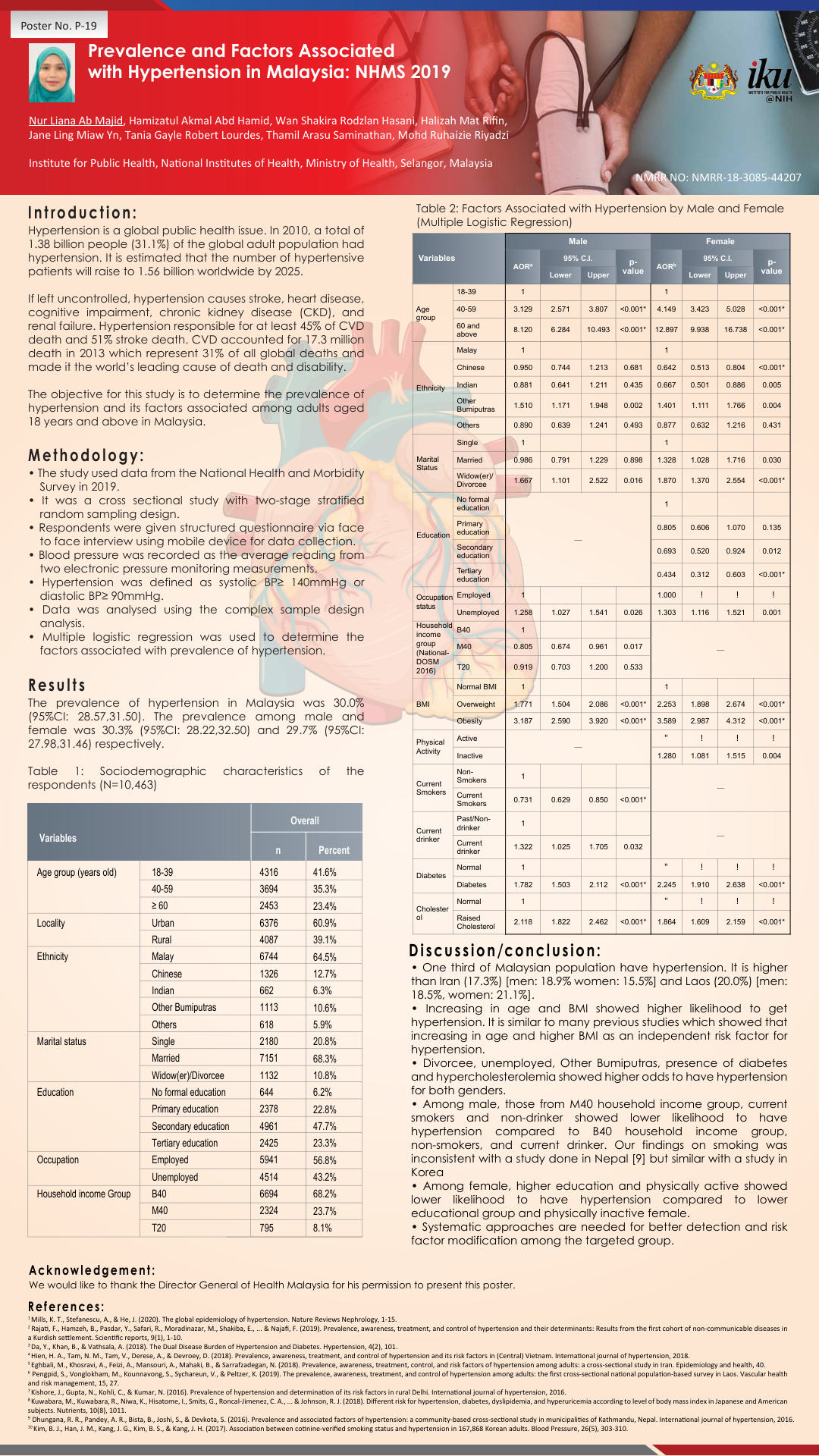
Introduction Hypertension is a global public health issue. In 2010, a total of 1.38 billion people (31.1%) of the global adult population had hypertension. It is estimated that the number of hypertensive patients will raise to 1.56 billion worldwide by 2025. If left uncontrolled, hypertension causes stroke, heart disease, cognitive impairment, chronic kidney disease (CKD), and renal failure. Hypertension responsible for at least 45% of CVD death and 51% stroke death. CVD accounted for 17.3 million death in 2013 which represent 31% of all global deaths and made it the world’s leading cause of death and disability. The objective for this study is to determine the prevalence of hypertension and its factors associated among adults aged 18 years and above in Malaysia. Methodology The study used data from the National Health and Morbidity Survey in 2019. • It was a cross sectional study with two-stage stratified random sampling design. Respondents were given structured questionnaire via face to face interview using mobile device for data collection. Blood pressure was recorded as the average reading from two electronic pressure monitoring measurements. Hypertension was defined as systolic BP≥ 140mmHg or diastolic BP≥ 90mmHg. • Data was analysed using the complex sample design analysis. • Multiple logistic regression was used to determine the factors associated with prevalence of hypertension. Results The prevalence of hypertension in Malaysia was 30.0% (95%CI: 28.57,31.50). The prevalence among male and female was 30.3% (95%CI: 28.22,32.50) and 29.7% (95%CI: 27.98,31.46) respectively. Discussion One third of Malaysian population have hypertension. It is higher than Iran (17.3%) [men: 18.9% women: 15.5%] and Laos (20.0%) [men: 18.5%, women: 21.1%]. • Increasing in age and BMI showed higher likelihood to get hypertension. It is similar to many previous studies which showed that increasing in age and higher BMI as an independent risk factor for hypertension. • Divorcee, unemployed, Other Bumiputras, presence of diabetes and hypercholesterolemia showed higher odds to have hypertension for both genders. • Among male, those from M40 household income group, current smokers and non-drinker showed lower likelihood to have hypertension compared to B40 household income group, non-smokers, and current drinker. Our findings on smoking was inconsistent with a study done in Nepal [9] but similar with a study in Korea • Among female, higher education and physically active showed lower likelihood to have hypertension compared to lower educational group and physically inactive female. • Systematic approaches are needed for better detection and risk factor modification among the targeted group.
Conference Information
NHMS
Identifiers
Authors
Nur Liana Ab Majid
Institute for Public Health, National Institutes of Health, Ministry of Health Malaysia, Shah Alam, Selangor, Malaysia
Hamizatul Akmal Abd Hamid
Institute for Public Health, National Institutes of Health, Ministry of Health Malaysia, Shah Alam, Selangor, Malaysia
Wan Shakira Rodzlan Hasani
Institute for Public Health, National Institutes of Health, Ministry of Health Malaysia, Shah Alam, Selangor, Malaysia
Halizah Mat Rifin
Institute for Public Health, National Institutes of Health, Ministry of Health Malaysia, Shah Alam, Selangor, Malaysia
Jane Ling Miaw Yn
Institute for Public Health, National Institutes of Health, Ministry of Health Malaysia, Shah Alam, Selangor, Malaysia
Tania Gayle Robert Lourdes
Institute for Public Health, National Institutes of Health, Ministry of Health Malaysia, Shah Alam, Selangor, Malaysia
Thamil Arasu Saminathan
Institute for Public Health, National Institutes of Health, Ministry of Health Malaysia, Shah Alam, Selangor, Malaysia
Mohd Ruhaizie Riyadzi
Institute for Public Health, National Institutes of Health, Ministry of Health Malaysia, Shah Alam, Selangor, Malaysia