Description
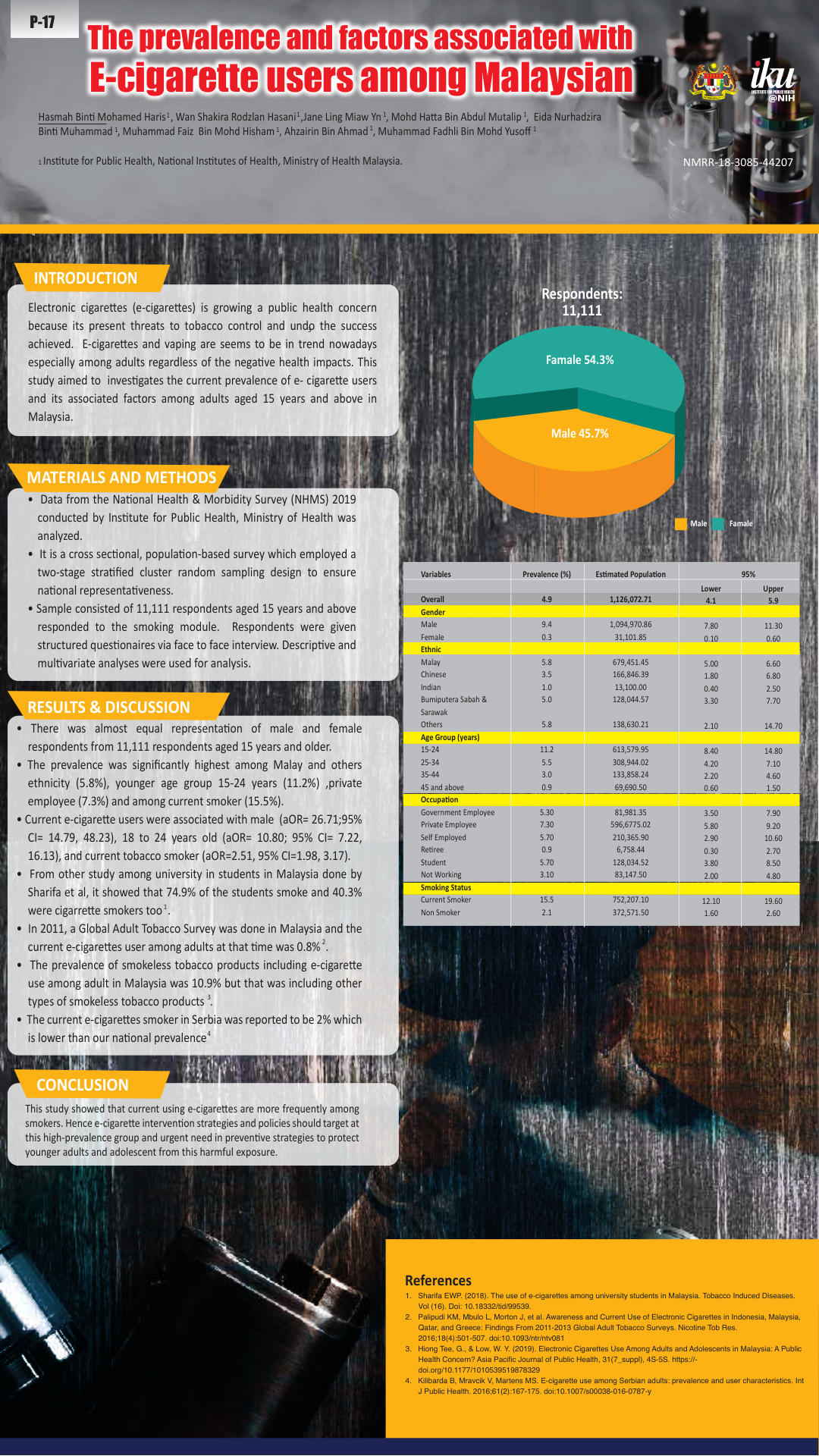
Introduction Electronic cigarettes (e-cigarettes) is growing a public health concern because its present threats to tobacco control and undo the success achieved. E-cigarettes and vaping are seems to be in trend nowadays especially among adults regardless of the negative health impacts. This study aimed to investigates the current prevalence of e- cigarette users and its associated factors among adults aged 15 years and above in Malaysia. Materials and Methods Data from the National Health & Morbidity Survey (NHMS) 2019 conducted by Institute for Public Health, Ministry of Health was analyzed. It is a cross sectional, population-based survey which employed a two-stage stratified cluster random sampling design to ensure national representativeness. Sample consisted of 11,111 respondents aged 15 years and above responded to the smoking module. Respondents were given structured questionaires via face to face interview. Descriptive and multivariate analyses were used for analysis. Results and Discussion There was almost equal representation of male and female respondents from 11,111 respondents aged 15 years and older. The prevalence was significantly highest among Malay and others ethnicity (5.8%), younger age group 15-24 years (11.2%) ,private employee (7.3%) and among current smoker (15.5%). Current e-cigarette users were associated with male (aOR= 26.71;95% CI= 14.79, 48.23), 18 to 24 years old (aOR= 10.80; 95% CI= 7.22, 16.13), and current tobacco smoker (aOR=2.51, 95% CI=1.98, 3.17). From other study among university in students in Malaysia done by Sharifa et al, it showed that 74.9% of the students smoke and 40.3% were cigarrette smokers too. In 2011, a Global Adult Tobacco Survey was done in Malaysia and the current e-cigarettes user among adults at that time was 0.8% . The prevalence of smokeless tobacco products including e-cigarette use among adult in Malaysia was 10.9% but that was including other types of smokeless tobacco products . The current e-cigarettes smoker in Serbia was reported to be 2% which is lower than our national prevalence. Conclusion This study showed that current using e-cigarettes are more frequently among smokers. Hence e-cigarette intervention strategies and policies should target at this high-prevalence group and urgent need in preventive strategies to protect younger adults and adolescent from this harmful exposure.
Identifiers
Authors
Hasmah Binti Mohamed Haris
Institute for Public Health, National Institutes of Health, Ministry of Health Malaysia, Shah Alam, Selangor, Malaysia
Wan Shakira Rodzlan Hasani
Institute for Public Health, National Institutes of Health, Ministry of Health Malaysia, Shah Alam, Selangor, Malaysia
Jane Ling Miaw Yn
Institute for Public Health, National Institutes of Health, Ministry of Health Malaysia, Shah Alam, Selangor, Malaysia
Mohd Hatta Bin Abdul Mutalip
Institute for Public Health, National Institutes of Health, Ministry of Health Malaysia, Shah Alam, Selangor, Malaysia
Eida Nurhadzira Binti Muhammad
Institute for Public Health, National Institutes of Health, Ministry of Health Malaysia, Shah Alam, Selangor, Malaysia
Muhammad Faiz Bin Mohd Hisham
Institute for Public Health, National Institutes of Health, Ministry of Health Malaysia, Shah Alam, Selangor, Malaysia
Ahzairin Bin Ahmad
Institute for Public Health, National Institutes of Health, Ministry of Health Malaysia, Shah Alam, Selangor, Malaysia
Muhammad Fadhli Bin Mohd Yusof
Institute for Public Health, National Institutes of Health, Ministry of Health Malaysia, Shah Alam, Selangor, Malaysia