Description
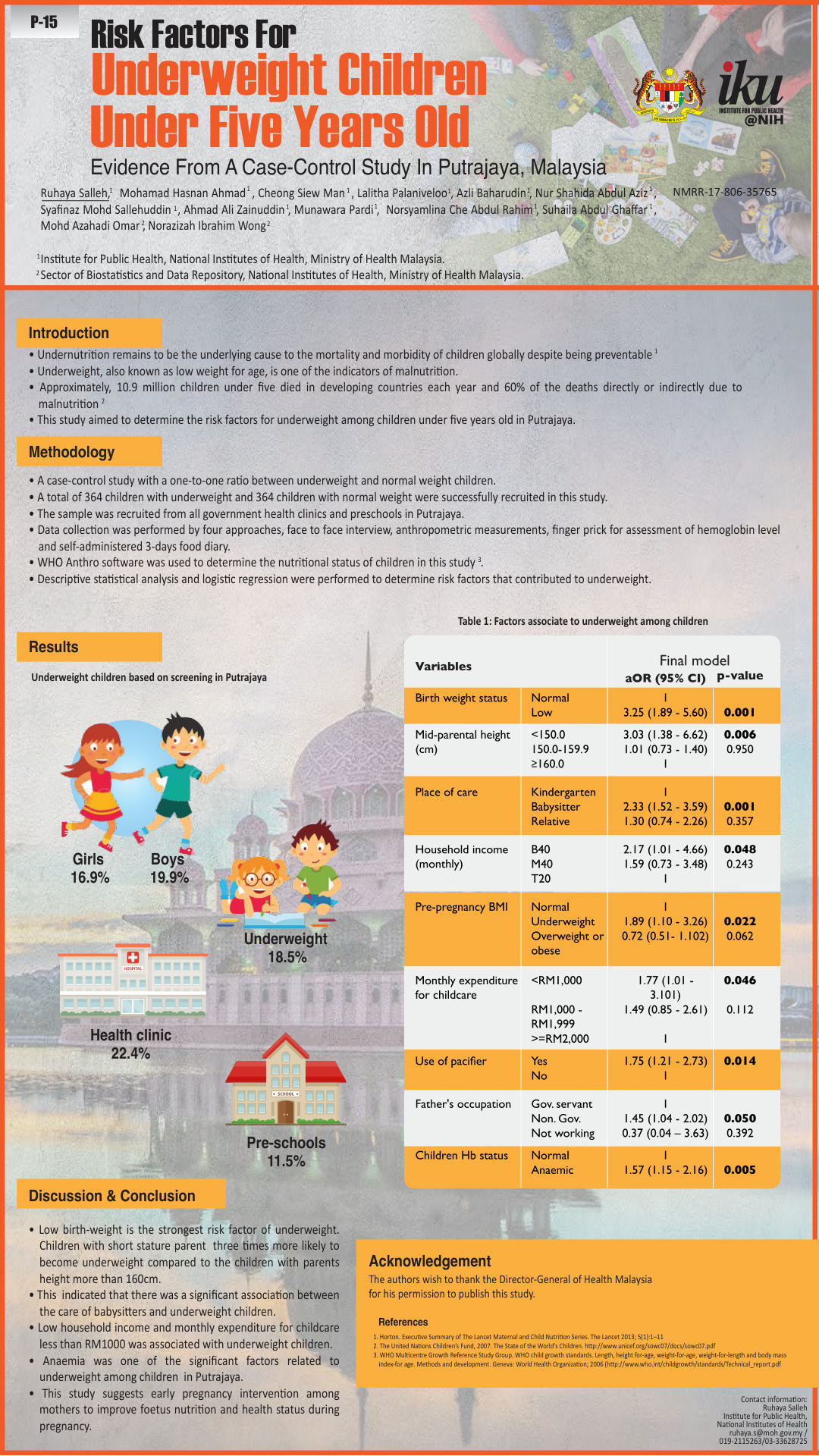
Introduction Undernutrition remains to be the underlying cause to the mortality and morbidity of children globally despite being preventable Underweight, also known as low weight for age, is one of the indicators of malnutrition. Approximately, 10.9 million children under five died in developing countries each year and 60% of the deaths directly or indirectly due to malnutrition. This study aimed to determine the risk factors for underweight among children under five years old in Putrajaya. Methodology A case-control study with a one-to-one ratio between underweight and normal weight children. total of 364 children with underweight and 364 children with normal weight were successfully recruited in this study. The sample was recruited from all government health clinics and preschools in Putrajaya. Data collection was performed by four approaches, face to face interview, anthropometric measurements, finger prick for assessment of hemoglobin level and self-administered 3-days food diary. WHO Anthro software was used to determine the nutritional status of children in this study. Descriptive statistical analysis and logistic regression were performed to determine risk factors that contributed to underweight. Results [Refer to Poster]. Discussion and Conclusion Low birth-weight is the strongest risk factor of underweight. Children with short stature parent three times more likely to become underweight compared to the children with parents height more than 160cm. This indicated that there was a significant association between the care of babysitters and underweight children. Low household income and monthly expenditure for childcare less than RM1000 was associated with underweight children. Anaemia was one of the significant factors related to underweight among children in Putrajaya. This study suggests early pregnancy intervention among mothers to improve foetus nutrition and health status during pregnancy.
Conference Information
NMRR-17-806-35765
Identifiers
Authors
Ruhaya Salleh
Institute for Public Health, National Institutes of Health, Ministry of Health Malaysia
ORCID: https://orcid.org/0000-0001-6418-840X
Mohamad Hasnan Ahmad
Institute for Public Health, National Institutes of Health, Ministry of Health Malaysia
ORCID: https://orcid.org/0000-0003-2280-2293
Cheong Siew Man
Institute for Public Health, National Institutes of Health, Ministry of Health Malaysia
ORCID: https://orcid.org/0000-0001-7756-0215
Lalitha Palaniveloo
Institute for Public Health, National Institutes of Health, Ministry of Health Malaysia
ORCID: https://orcid.org/0000-0002-0321-4229
Azli Baharudin
Institute for Public Health, National Institutes of Health, Ministry of Health Malaysia
ORCID: https://orcid.org/0000-0002-4762-780X
Nur Shahida Abdul Aziz
Institute for Public Health, National Institutes of Health, Ministry of Health Malaysia
ORCID: https://orcid.org/0000-0002-7138-7711
Syafinaz Mohd Sallehuddin
Institute for Public Health, National Institutes of Health, Ministry of Health Malaysia
ORCID: https://orcid.org/0000-0003-1574-6094
Ahmad Ali Zainuddin
Institute for Public Health, National Institutes of Health, Ministry of Health Malaysia
ORCID: https://orcid.org/0000-0003-4016-6809
Munawara Pardi
Institute for Public Health, National Institutes of Health, Ministry of Health Malaysia
ORCID: https://orcid.org/0000-0002-5715-4196
Norsyamlina Che Abdul Rahim
Institute for Public Health, National Institutes of Health, Ministry of Health Malaysia
ORCID: https://orcid.org/0000-0003-4045-6566
Suhaila Abdul Ghaffar
Institute for Public Health, National Institutes of Health, Ministry of Health Malaysia
ORCID: https://orcid.org/0000-0001-7179-0351
Mohd Azahadi Omar
Sector for Biostatistics & Data Repository, National Institutes of Health (NIH), Ministry of Health, Malaysia
ORCID: https://orcid.org/0000-0002-5171-851X
Norazizah Ibrahim Wong
Sector for Biostatistics & Data Repository, National Institutes of Health (NIH), Ministry of Health, Malaysia
ORCID: https://orcid.org/0000-0002-3357-4524