Description
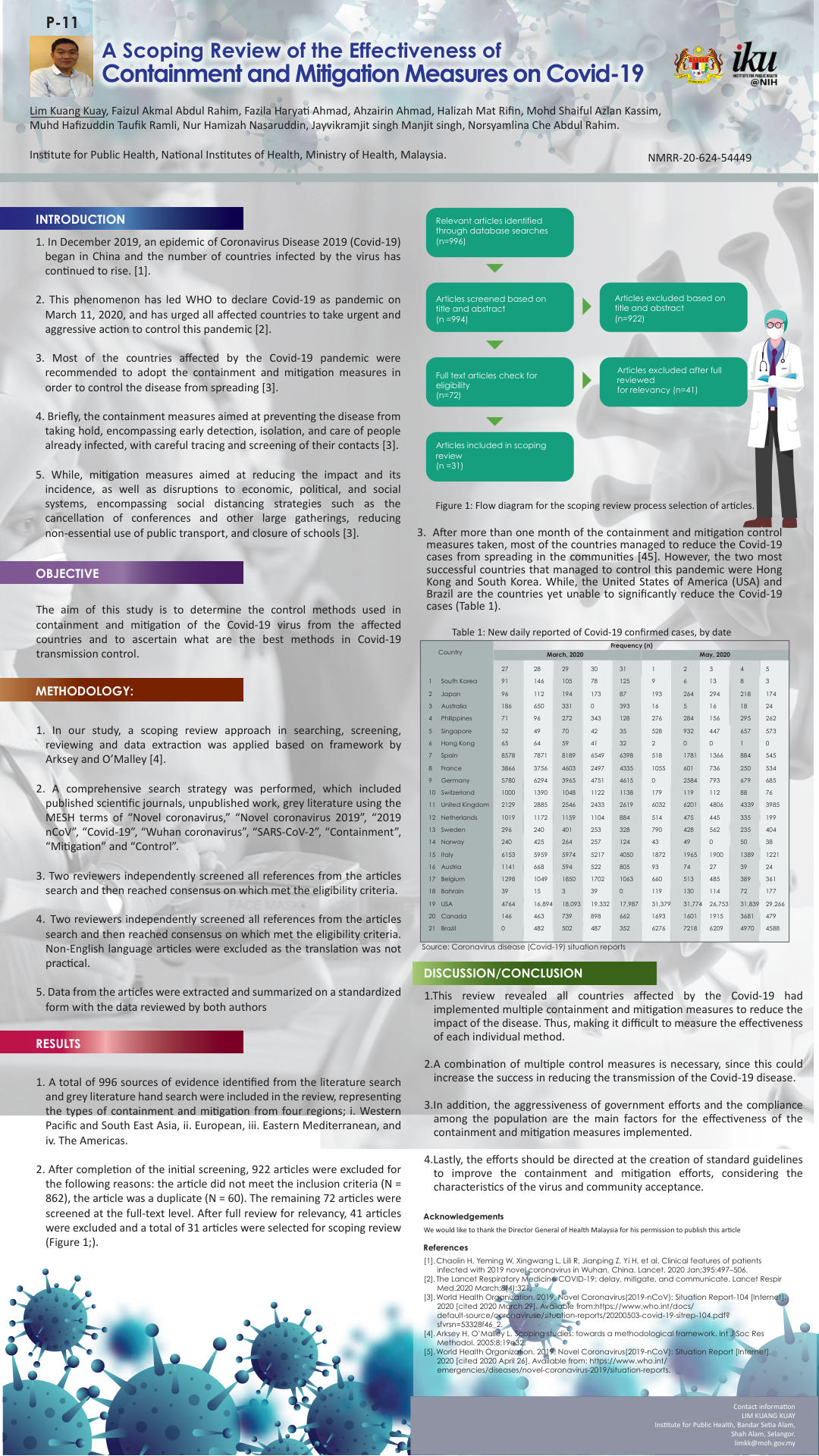
Introduction In December 2019, an epidemic of Coronavirus Disease 2019 (Covid-19) began in China and the number of countries infected by the virus has continued to rise. This phenomenon has led WHO to declare Covid-19 as pandemic on March 11, 2020, and has urged all affected countries to take urgent and aggressive action to control this pandemic. Most of the countries affected by the Covid-19 pandemic were recommended to adopt the containment and mitigation measures in order to control the disease from spreading. Briefly, the containment measures aimed at preventing the disease from taking hold, encompassing early detection, isolation, and care of people already infected, with careful tracing and screening of their contacts. While, mitigation measures aimed at reducing the impact and its incidence, as well as disruptions to economic, political, and social systems, encompassing social distancing strategies such as the cancellation of conferences and other large gatherings, reducing non-essential use of public transport, and closure of schools. Objective The aim of this study is to determine the control methods used in containment and mitigation of the Covid-19 virus from the affected countries and to ascertain what are the best methods in Covid-19 transmission control. Methodology In our study, a scoping review approach in searching, screening, reviewing and data extraction was applied based on framework by Arksey and O’Malley. A comprehensive search strategy was performed, which included published scientific journals, unpublished work, grey literature using the MESH terms of “Novel coronavirus,” “Novel coronavirus 2019”, “2019 nCoV”, “Covid-19”, “Wuhan coronavirus”, “SARS-CoV-2”, “Containment”, “Mitigation” and “Control”. Two reviewers independently screened all references from the articles search and then reached consensus on which met the eligibility criteria. Two reviewers independently screened all references from the articles search and then reached consensus on which met the eligibility criteria. Non-English language articles were excluded as the translation was not practical. Data from the articles were extracted and summarized on a standardized form with the data reviewed by both authors. Results A total of 996 sources of evidence identified from the literature search and grey literature hand search were included in the review, representing the types of containment and mitigation from four regions; i. Western Pacific and South East Asia, ii. European, iii. Eastern Mediterranean, and iv. The Americas. After completion of the initial screening, 922 articles were excluded for the following reasons: the article did not meet the inclusion criteria (N = 862), the article was a duplicate (N = 60). The remaining 72 articles were screened at the full-text level. After full review for relevancy, 41 articles were excluded and a total of 31 articles were selected for scoping review (Figure 1;). After more than one month of the containment and mitigation control measures taken, most of the countries managed to reduce the Covid-19 cases from spreading in the communities [45]. However, the two most successful countries that managed to control this pandemic were Hong Kong and South Korea. While, the United States of America (USA) and Brazil are the countries yet unable to significantly reduce the Covid-19 cases (Table 1). Conclusion This review revealed all countries affected by the Covid-19 had implemented multiple containment and mitigation measures to reduce the impact of the disease. Thus, making it difficult to measure the effectiveness of each individual method. A combination of multiple control measures is necessary, since this could increase the success in reducing the transmission of the Covid-19 disease. In addition, the aggressiveness of government efforts and the compliance among the population are the main factors for the effectiveness of the containment and mitigation measures implemented. Lastly, the efforts should be directed at the creation of standard guidelines to improve the containment and mitigation efforts, considering the characteristics of the virus and community acceptance.
Conference Information
NMRR-20-624-54449
Identifiers
Authors
Lim Kuang Kuay
Institute for Public Health, National Institutes of Health, Ministry of Health Malaysia, Shah Alam, Selangor, Malaysia
ORCID: https://orcid.org/0000-0002-5162-3983
Faizul Akmal Abdul Rahim
Institute for Public Health, National Institutes of Health, Ministry of Health Malaysia, Shah Alam, Selangor, Malaysia
ORCID: https://orcid.org/0000-0002-7278-7645
Fazila Haryati Ahmad
Institute for Public Health, National Institutes of Health, Ministry of Health Malaysia, Shah Alam, Selangor, Malaysia
Ahzairin Ahmad
Institute for Public Health, National Institutes of Health, Ministry of Health Malaysia, Shah Alam, Selangor, Malaysia
Halizah Mat Rifin
Institute for Public Health, National Institutes of Health, Ministry of Health Malaysia, Shah Alam, Selangor, Malaysia
Mohd Shaiful Azlan Kassim
Institute for Public Health, National Institutes of Health, Ministry of Health Malaysia, Shah Alam, Selangor, Malaysia
Muhd Hafizuddin Taufik Ramli
Institute for Public Health, National Institutes of Health, Ministry of Health Malaysia, Shah Alam, Selangor, Malaysia
Nur Hamizah Nasaruddin
Institute for Public Health, National Institutes of Health, Ministry of Health Malaysia, Shah Alam, Selangor, Malaysia
Jayvikramjit singh Manjit Singh
Institute for Public Health, National Institutes of Health, Ministry of Health Malaysia, Shah Alam, Selangor, Malaysia
Norsyamlina Che Abdul Rahim
Institute for Public Health, National Institutes of Health, Ministry of Health Malaysia, Shah Alam, Selangor, Malaysia