Prevalence of Diabetes and its Associated Factors Among the Malaysian Adults Population: National Health and Morbidity Survey 2019
Description
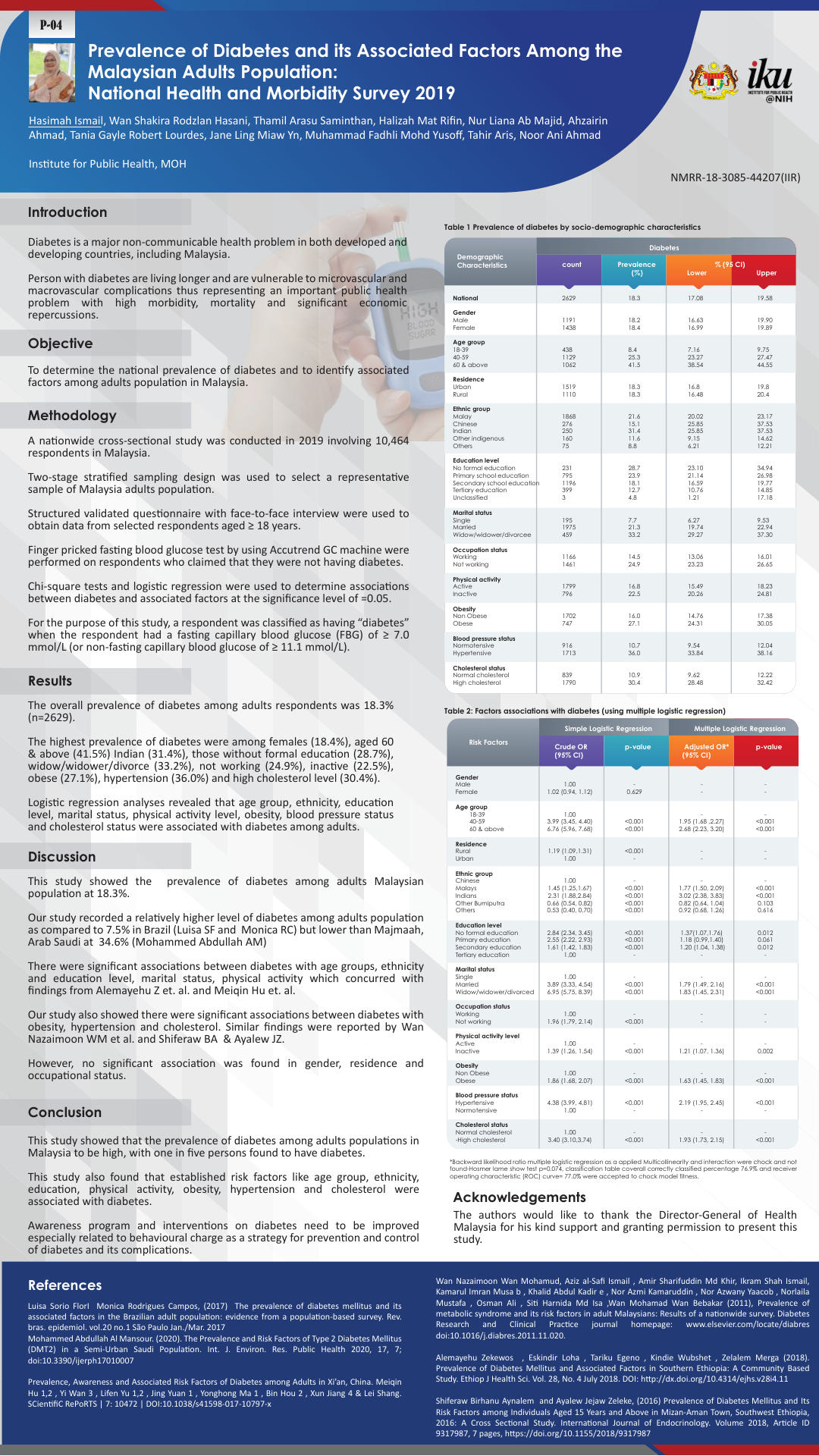
Introduction Diabetes is a major non-communicable health problem in both developed and developing countries, including Malaysia. Person with diabetes are living longer and are vulnerable to microvascular and macrovascular complications thus representing an important public health problem with high morbidity, mortality and significant economic repercussions. Objective To determine the national prevalence of diabetes and to identify associated factors among adults population in Malaysia. Methodology A nationwide cross-sectional study was conducted in 2019 involving 10,464 respondents in Malaysia. Two-stage stratified sampling design was used to select a representative sample of Malaysia adults population. Structured validated questionnaire with face-to-face interview were used to obtain data from selected respondents aged ≥ 18 years. Finger pricked fasting blood glucose test by using Accutrend GC machine were performed on respondents who claimed that they were not having diabetes. Chi-square tests and logistic regression were used to determine associations between diabetes and associated factors at the significance level of =0.05. For the purpose of this study, a respondent was classified as having “diabetes” when the respondent had a fasting capillary blood glucose (FBG) of ≥ 7.0 mmol/L (or non-fasting capillary blood glucose of ≥ 11.1 mmol/L). Results The overall prevalence of diabetes among adults respondents was 18.3% (n=2629). The highest prevalence of diabetes were among females (18.4%), aged 60 & above (41.5%) Indian (31.4%), those without formal education (28.7%), widow/widower/divorce (33.2%), not working (24.9%), inactive (22.5%), obese (27.1%), hypertension (36.0%) and high cholesterol level (30.4%). Logistic regression analyses revealed that age group, ethnicity, education level, marital status, physical activity level, obesity, blood pressure status and cholesterol status were associated with diabetes among adults. Discussion This study showed the prevalence of diabetes among adults Malaysian population at 18.3%. Our study recorded a relatively higher level of diabetes among adults population as compared to 7.5% in Brazil (Luisa SF and Monica RC) but lower than Majmaah, Arab Saudi at 34.6% (Mohammed Abdullah AM) There were significant associations between diabetes with age groups, ethnicity and education level, marital status, physical activity which concurred with findings from Alemayehu Z et. al. and Meiqin Hu et. al. Our study also showed there were significant associations between diabetes with obesity, hypertension and cholesterol. Similar findings were reported by Wan Nazaimoon WM et al. and Shiferaw BA & Ayalew JZ. However, no significant association was found in gender, residence and occupational status. Conclusion This study showed that the prevalence of diabetes among adults populations in Malaysia to be high, with one in five persons found to have diabetes. This study also found that established risk factors like age group, ethnicity, education, physical activity, obesity, hypertension and cholesterol were associated with diabetes. Awareness program and interventions on diabetes need to be improved especially related to behavioural charge as a strategy for prevention and control of diabetes and its complications.
Conference Information
National Health and Morbidity Survey
Identifiers
Authors
Hasimah Ismail
Institute for Public Health, National Institutes of Health, Ministry of Health Malaysia, Shah Alam, Selangor, Malaysia
Wan Shakira Rodzlan Hasani
Institute for Public Health, National Institutes of Health, Ministry of Health Malaysia, Shah Alam, Selangor, Malaysia
Thamil Arasu Saminthan
Institute for Public Health, National Institutes of Health, Ministry of Health Malaysia, Shah Alam, Selangor, Malaysia
Halizah Mat Rifin
Institute for Public Health, National Institutes of Health, Ministry of Health Malaysia, Shah Alam, Selangor, Malaysia
Nur Liana Ab Majid
Institute for Public Health, National Institutes of Health, Ministry of Health Malaysia, Shah Alam, Selangor, Malaysia
Ahzairin Ahmad
Institute for Public Health, National Institutes of Health, Ministry of Health Malaysia, Shah Alam, Selangor, Malaysia
Tania Gayle Robert Lourdes
Institute for Public Health, National Institutes of Health, Ministry of Health Malaysia, Shah Alam, Selangor, Malaysia
Jane Ling Miaw Yn
Institute for Public Health, National Institutes of Health, Ministry of Health Malaysia, Shah Alam, Selangor, Malaysia
Muhammad Fadhli Mohd Yusof
Institute for Public Health, National Institutes of Health, Ministry of Health Malaysia, Shah Alam, Selangor, Malaysia
Tahir Aris
Institute for Public Health, National Institutes of Health, Ministry of Health Malaysia, Shah Alam, Selangor, Malaysia
Noor Ani Ahmad
Institute for Public Health, National Institutes of Health, Ministry of Health Malaysia, Shah Alam, Selangor, Malaysia
Muhammad Fadhli Mohd Yusoff
Institute for Public Health, MOH