Description
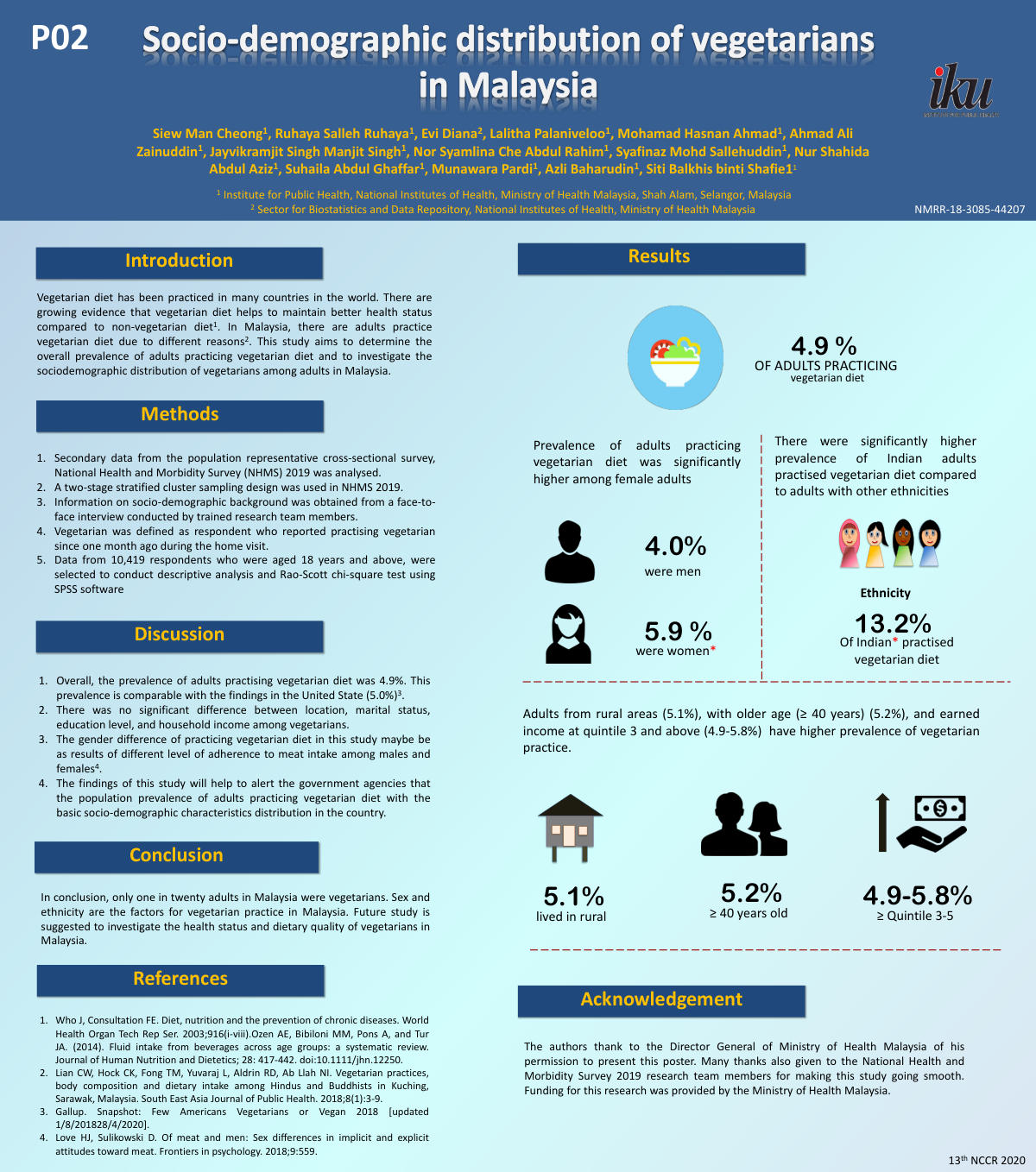
Introduction Vegetarian diet has been practiced in many countries in the world. There are growing evidence that vegetarian diet helps to maintain better health status compared to non-vegetarian diet. In Malaysia, there are adults practice vegetarian diet due to different reasons . This study aims to determine the overall prevalence of adults practicing vegetarian diet and to investigate the sociodemographic distribution of vegetarians among adults in Malaysia. Methods 1. Secondary data from the population representative cross-sectional survey, National Health and Morbidity Survey (NHMS) 2019 was analysed. 2. A two-stage stratified cluster sampling design was used in NHMS 2019. 3. Information on socio-demographic background was obtained from a face-toface interview conducted by trained research team members. 4. Vegetarian was defined as respondent who reported practising vegetarian since one month ago during the home visit. 5. Data from 10,419 respondents who were aged 18 years and above, were selected to conduct descriptive analysis and Rao-Scott chi-square test using SPSS software. Results [Refer to Poster]. Discussion Overall, the prevalence of adults practising vegetarian diet was 4.9%. This prevalence is comparable with the findings in the United State (5.0%) 3 . 2. There was no significant difference between location, marital status, education level, and household income among vegetarians. 3. The gender difference of practicing vegetarian diet in this study maybe be as results of different level of adherence to meat intake among males and females4 . 4. The findings of this study will help to alert the government agencies that the population prevalence of adults practicing vegetarian diet with the basic socio-demographic characteristics distribution in the country Conclusion In conclusion, only one in twenty adults in Malaysia were vegetarians. Sex and ethnicity are the factors for vegetarian practice in Malaysia. Future study is suggested to investigate the health status and dietary quality of vegetarians in Malaysia.
Identifiers
Authors
Siew Man Cheong
Institute for Public Health, National Institutes of Health, Ministry of Health Malaysia, Shah Alam, Selangor, Malaysia
ORCID: https://orcid.org/0000-0001-7756-0215
Ruhaya Salleh Ruhaya
Institute for Public Health, National Institutes of Health, Ministry of Health Malaysia, Shah Alam, Selangor, Malaysia
Evi Diana
National Institutes of Health
Lalitha Palaniveloo
Institute for Public Health, National Institutes of Health, Ministry of Health Malaysia, Shah Alam, Selangor, Malaysia
Mohamad Hasnan Ahmad
Institute for Public Health, National Institutes of Health, Ministry of Health Malaysia, Shah Alam, Selangor, Malaysia
Ahmad Ali Zainuddin
Institute for Public Health, National Institutes of Health, Ministry of Health Malaysia, Shah Alam, Selangor, Malaysia
Jayvikramjit Singh Manjit Singh
Institute for Public Health, National Institutes of Health, Ministry of Health Malaysia, Shah Alam, Selangor, Malaysia
Nor Syamlina Che Abdul Rahim
Institute for Public Health, National Institutes of Health, Ministry of Health Malaysia, Shah Alam, Selangor, Malaysia
Syafinaz Mohd Sallehuddin
Institute for Public Health, National Institutes of Health, Ministry of Health Malaysia, Shah Alam, Selangor, Malaysia
Nur Shahida Abdul Aziz
Institute for Public Health, National Institutes of Health, Ministry of Health Malaysia, Shah Alam, Selangor, Malaysia
Suhaila Abdul Ghaffar
Institute for Public Health, National Institutes of Health, Ministry of Health Malaysia, Shah Alam, Selangor, Malaysia
Munawara Pardi
Institute for Public Health, National Institutes of Health, Ministry of Health Malaysia, Shah Alam, Selangor, Malaysia
Azli Baharudin
Institute for Public Health, National Institutes of Health, Ministry of Health Malaysia, Shah Alam, Selangor, Malaysia
Siti Balkhis binti Shafie
Institute for Public Health, National Institutes of Health, Ministry of Health Malaysia, Shah Alam, Selangor, Malaysia