Description
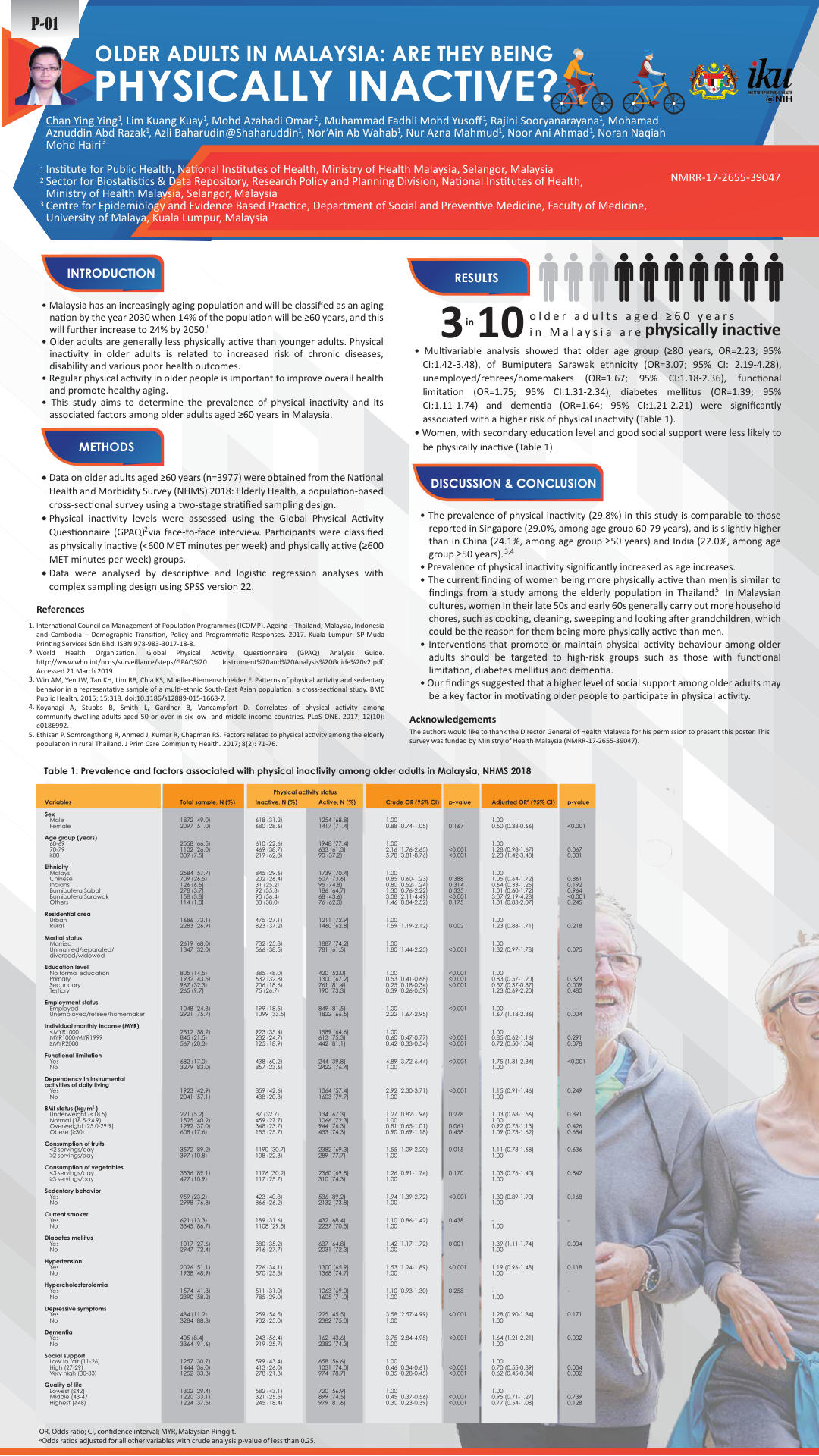
Introduction Malaysia has an increasingly aging population and will be classified as an aging nation by the year 2030 when 14% of the population will be ≥60 years, and this will further increase to 24% by 2050. Older adults are generally less physically active than younger adults. Physical inactivity in older adults is related to increased risk of chronic diseases, disability and various poor health outcomes. Regular physical activity in older people is important to improve overall health and promote healthy aging. This study aims to determine the prevalence of physical inactivity and its associated factors among older adults aged ≥60 years in Malaysia. Methods Data on older adults aged ≥60 years (n=3977) were obtained from the National Health and Morbidity Survey (NHMS) 2018: Elderly Health, a population-based cross-sectional survey using a two-stage stratified sampling design. Physical inactivity levels were assessed using the Global Physical Activity Questionnaire (GPAQ) via face-to-face interview. Participants were classified as physically inactive (<600 MET minutes per week) and physically active (≥600 MET minutes per week) groups. Data were analysed by descriptive and logistic regression analyses with complex sampling design using SPSS version 22. Results Multivariable analysis showed that older age group (≥80 years, OR=2.23; 95% CI:1.42-3.48), of Bumiputera Sarawak ethnicity (OR=3.07; 95% CI: 2.19-4.28), unemployed/retirees/homemakers (OR=1.67; 95% CI:1.18-2.36), functional limitation (OR=1.75; 95% CI:1.31-2.34), diabetes mellitus (OR=1.39; 95% CI:1.11-1.74) and dementia (OR=1.64; 95% CI:1.21-2.21) were significantly associated with a higher risk of physical inactivity (Table 1). Women, with secondary education level and good social support were less likely to be physically inactive (Table 1). Discussion and Conclusion The prevalence of physical inactivity (29.8%) in this study is comparable to those reported in Singapore (29.0%, among age group 60-79 years), and is slightly higher than in China (24.1%, among age group ≥50 years) and India (22.0%, among age group ≥50 years). Prevalence of physical inactivity significantly increased as age increases. The current finding of women being more physically active than men is similar to findings from a study among the elderly population in Thailand. In Malaysian cultures, women in their late 50s and early 60s generally carry out more household chores, such as cooking, cleaning, sweeping and looking after grandchildren, which could be the reason for them being more physically active than men. Interventions that promote or maintain physical activity behaviour among older adults should be targeted to high-risk groups such as those with functional limitation, diabetes mellitus and dementia. Our findings suggested that a higher level of social support among older adults may be a key factor in motivating older people to participate in physical activity.
Identifiers
Authors
Chan Ying Ying
Institute for Public Health, National Institutes of Health, Ministry of Health Malaysia, Selangor, Malaysia
ORCID: https://orcid.org/0000-0001-7750-0909
Lim Kuang Kuay
Institute for Public Health, National Institutes of Health, Ministry of Health Malaysia, Selangor, Malaysia
Mohd Azahadi Omar
Sector for Biostatistics & Data Repository, Research Policy and Planning Division, National Institutes of Health, Ministry of Health Malaysia, Selangor, Malaysia
ORCID: https://orcid.org/0000-0002-5171-851X
Muhammad Fadhli Mohd Yusoff
Institute for Public Health, National Institutes of Health, Ministry of Health Malaysia, Selangor, Malaysia
Rajini Sooryanarayana
Institute for Public Health, National Institutes of Health, Ministry of Health Malaysia, Selangor, Malaysia
ORCID: https://orcid.org/0000-0001-8927-4160
Mohamad Aznuddin Abd Razak
Institute for Public Health, National Institutes of Health, Ministry of Health Malaysia, Selangor, Malaysia
ORCID: https://orcid.org/0000-0002-5330-8100
Azli Baharudin@Shaharuddin
Institute for Public Health, National Institutes of Health, Ministry of Health Malaysia, Selangor, Malaysia
Nor'Ain Ab Wahab
Institute for Public Health, National Institutes of Health, Ministry of Health Malaysia, Selangor, Malaysia
Nur Azna Mahmud
Institute for Public Health, National Institutes of Health, Ministry of Health Malaysia, Selangor, Malaysia
Noor Ani Ahmad
Institute for Public Health, National Institutes of Health, Ministry of Health Malaysia, Selangor, Malaysia
Noran Naqiah Mohd Hairi
Centre for Epidemiology and Evidence Based Practice, Department of Social and Preventive Medicine, Faculty of Medicine, University of Malaya, Kuala Lumpur, Malaysia