Description
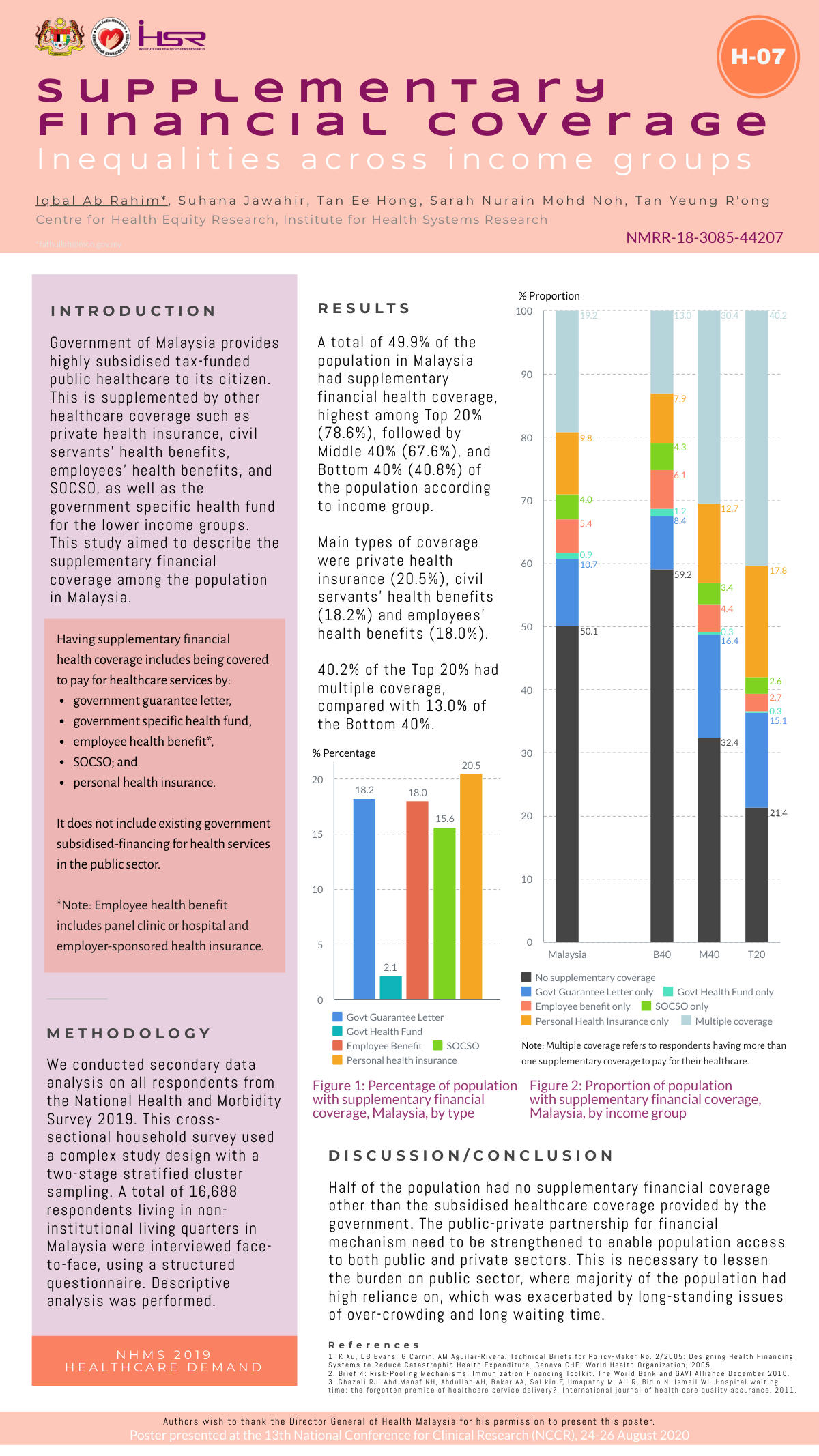
Introduction Government of Malaysia provides highly subsidised tax-funded public healthcare to its citizen. This is supplemented by other healthcare coverage such as private health insurance, civil servants’ health benefits, employees’ health benefits, and SOCSO, as well as the government specific health fund for the lower income groups. This study aimed to describe the supplementary financial coverage among the population in Malaysia. Having supplementary financial health coverage includes being covered to pay for healthcare services by: government guarantee letter, government-specific health fund, employee health benefit* , SOCSO; and personal health insurance. It does not include existing government subsidised-financing for health services in the publicsector. *Note: Employee health benefit includes panelclinic or hospital and employer-sponsored health insurance. Methodology We conducted secondary data analysis on all respondents from the National Health and Morbidity Survey 2019. This crosssectional household survey used a complex study design with a two-stage stratified cluster sampling. A total of 16,688 respondents living in non-institutional living quarters in Malaysia were interviewed faceto-face, using a structured questionnaire. Descriptive analysis was performed. Results [Refer to Report]. Discussion / Conclusion Half of the population had no supplementary financial coverage other than the subsidised healthcare coverage provided by the government. The public-private partnership for financial mechanism need to be strengthened to enable population access to both public and private sectors. This is necessary to lessen the burden on public sector, where majority of the population had high reliance on, which was exacerbated by long-standing issues of over-crowding and long waiting time.
Conference Information
13th National Conference for Clinical Research (NCCR)
Identifiers
Authors
Iqbal Ab Rahim
Cente for Health Equity Research, Institute for Health Systems Research
Suhana Jawahir
Centre for Health Equity Research, Institute for Health Systems Research
Tan Ee Hong
Cente for Health Equity Research, Institute for Health Systems Research
Sarah Nurain Mohd Noh
Cente for Health Equity Research, Institute for Health Systems Research
Tan Yeung R'ong
Cente for Health Equity Research, Institute for Health Systems Research
A. B. R. Iqbal
Centre for Health Equity Research, Institute for Health Systems Research
T. E. Eong
Centre for Health Equity Research, Institute for Health Systems Research
S. N. Mohd Nor
Centre for Health Equity Research, Institute for Health Systems Research
T. Y. Yong
Centre for Health Equity Research, Institute for Health Systems Research