Description
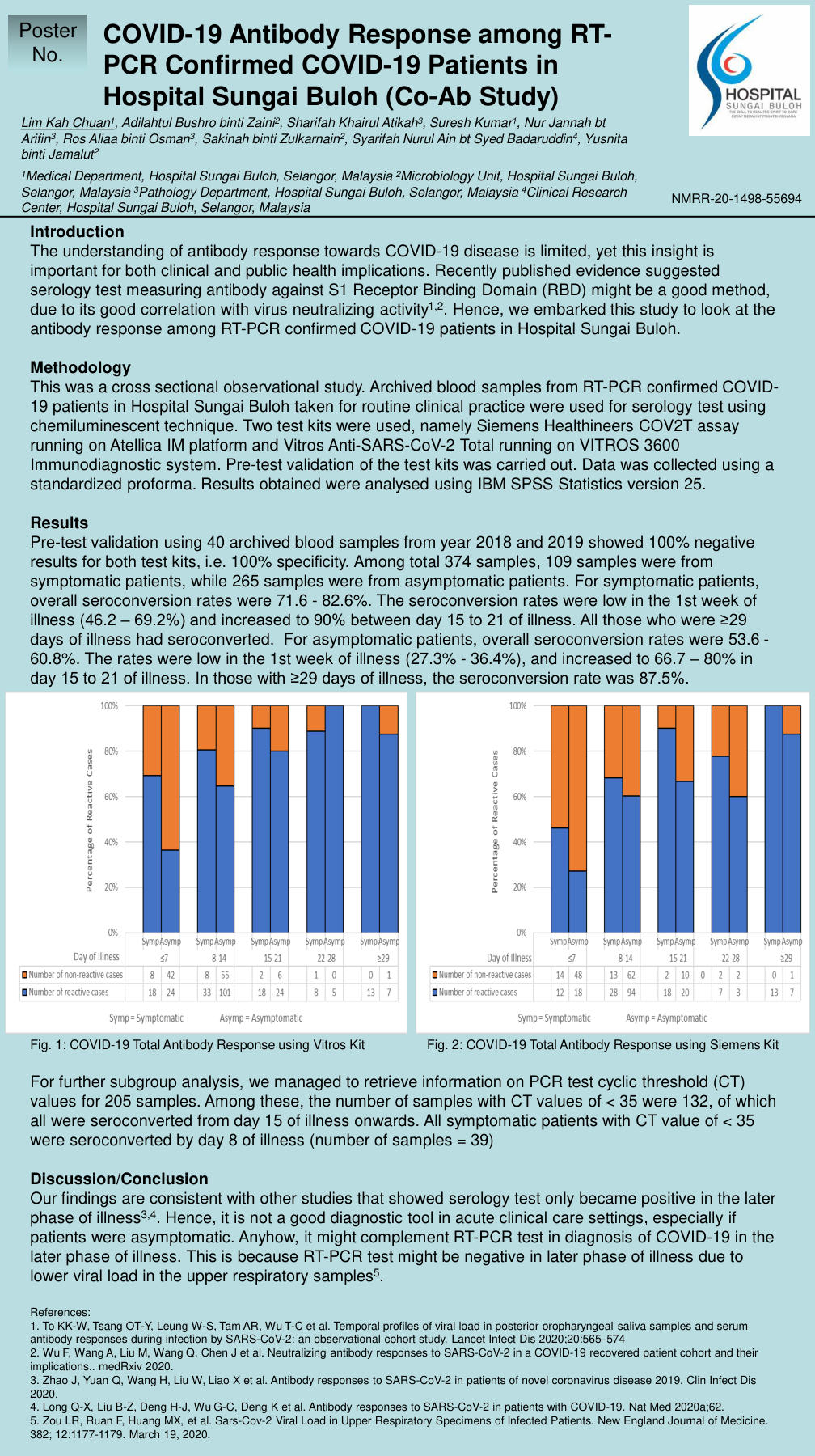
Introduction The understanding of antibody response towards COVID-19 disease is limited, yet this insight is important for both clinical and public health implications. Recently published evidence suggested serology test measuring antibody against S1 Receptor Binding Domain (RBD) might be a good method, due to its good correlation with virus neutralizing activity. Hence, we embarked this study to look at the antibody response among RT-PCR confirmed COVID-19 patients in Hospital Sungai Buloh. Methodology This was a cross sectional observational study. Archived blood samples from RT-PCR confirmed COVID19 patients in Hospital Sungai Buloh taken for routine clinical practice were used for serology test using chemiluminescent technique. Two test kits were used, namely Siemens Healthineers COV2T assay running on Atellica IM platform and Vitros Anti-SARS-CoV-2 Total running on VITROS 3600 Immunodiagnostic system. Pre-test validation of the test kits was carried out. Data was collected using a standardized proforma. Results obtained were analysed using IBM SPSS Statistics version 25. Results Pre-test validation using 40 archived blood samples from year 2018 and 2019 showed 100% negative results for both test kits, i.e. 100% specificity. Among total 374 samples, 109 samples were from symptomatic patients, while 265 samples were from asymptomatic patients. For symptomatic patients, overall seroconversion rates were 71.6 - 82.6%. The seroconversion rates were low in the 1st week of illness (46.2 – 69.2%) and increased to 90% between day 15 to 21 of illness. All those who were ≥29 days of illness had seroconverted. For asymptomatic patients, overall seroconversion rates were 53.6 - 60.8%. The rates were low in the 1st week of illness (27.3% - 36.4%), and increased to 66.7 – 80% in day 15 to 21 of illness. In those with ≥29 days of illness, the seroconversion rate was 87.5%. For further subgroup analysis, we managed to retrieve information on PCR test cyclic threshold (CT) values for 205 samples. Among these, the number of samples with CT values of < 35 were 132, of which all were seroconverted from day 15 of illness onwards. All symptomatic patients with CT value of < 35 were seroconverted by day 8 of illness (number of samples = 39). Discussion / Conclusion Our findings are consistent with other studies that showed serology test only became positive in the later phase of illness. Hence, it is not a good diagnostic tool in acute clinical care settings, especially if patients were asymptomatic. Anyhow, it might complement RT-PCR test in diagnosis of COVID-19 in the later phase of illness. This is because RT-PCR test might be negative in later phase of illness due to lower viral load in the upper respiratory samples5 .
Conference Information
NMRR-20-1498-55694
Identifiers
Authors
Lim Kah Chuan
Medical Department, Sungai Buloh Hospital
Adilahtul Bushro binti Zaini
Microbiology Unit, Hospital Sungai Buloh, Selangor, Malaysia
Sharifah Khairul Atikah
Pathology Department, Hospital Sungai Buloh, Selangor, Malaysia
Suresh Kumar
Medical Department, Sungai Buloh Hospital
Nur Jannah bt Arifin
Pathology Department, Hospital Sungai Buloh, Selangor, Malaysia
Ros Aliaa binti Osman
Pathology Department, Hospital Sungai Buloh, Selangor, Malaysia
Sakinah binti Zulkarnain
Microbiology Unit, Hospital Sungai Buloh, Selangor, Malaysia
Syarifah Nurul Ain bt Syed Badaruddin
Clinical Research Centre, Hospital Sungai Buloh
Yusnita binti Jamalut
Microbiology Unit, Hospital Sungai Buloh, Selangor, Malaysia