Description
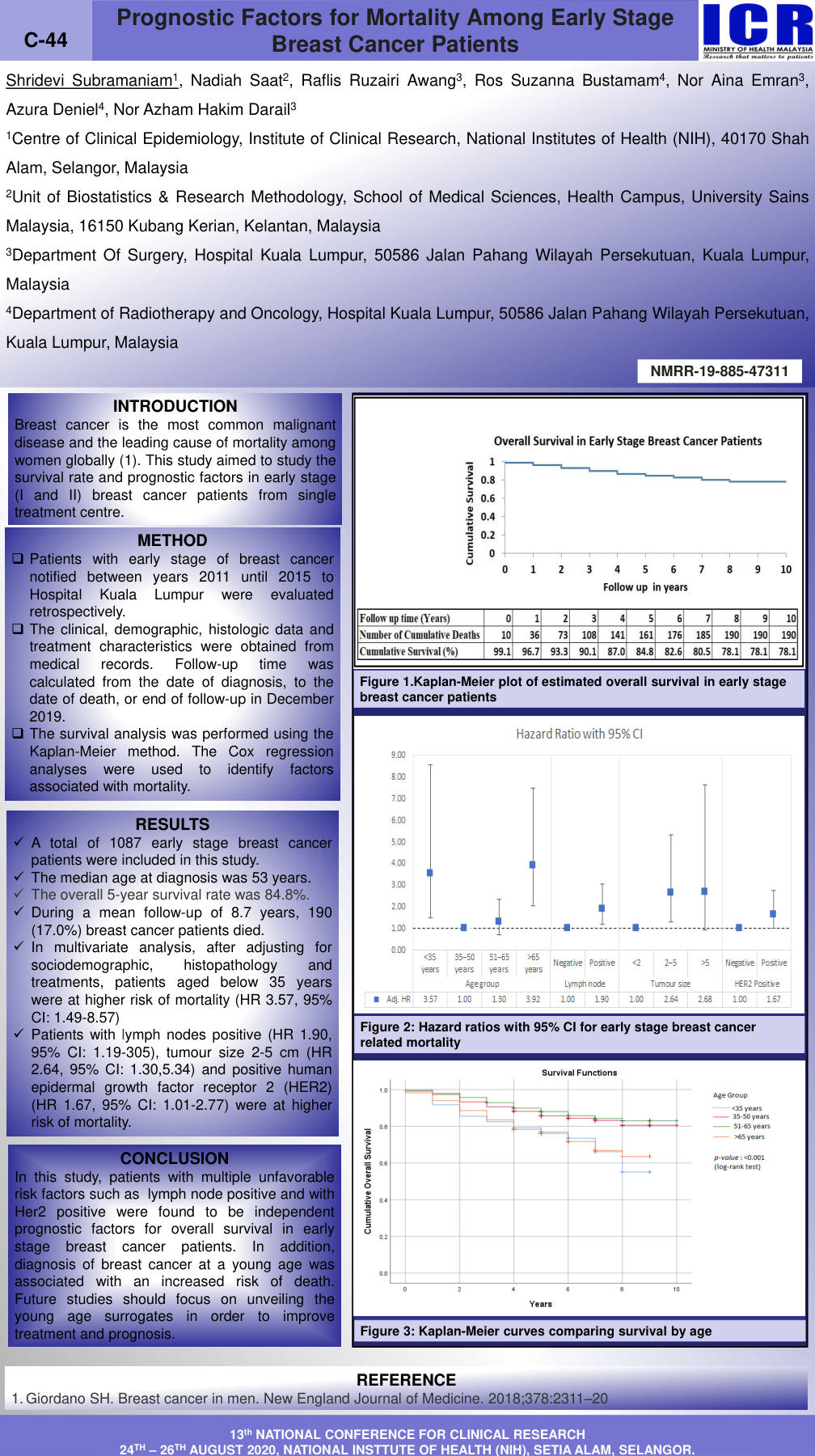
Introduction Breast cancer is the most common malignant disease and the leading cause of mortality among women globally. This study aimed to study the survival rate and prognostic factors in early stage (I and II) breast cancer patients from single treatment centre. Methods Patients with early stage of breast cancer notified between years 2011 until 2015 to Hospital Kuala Lumpur were evaluated retrospectively. The clinical, demographic, histologic data and treatment characteristics were obtained from medical records. Follow-up time was calculated from the date of diagnosis, to the date of death, or end of follow-up in December 2019. The survival analysis was performed using the Kaplan-Meier method. The Cox regression analyses were used to identify factors associated with mortality. Results A total of 1087 early stage breast cancer patients were included in this study. The median age at diagnosis was 53 years. The overall 5-year survival rate was 84.8%. During a mean follow-up of 8.7 years, 190 (17.0%) breast cancer patients died. In multivariate analysis, after adjusting for sociodemographic, histopathology and treatments, patients aged below 35 years were at higher risk of mortality (HR 3.57, 95% CI: 1.49-8.57) ✓ Patients with lymph nodes positive (HR 1.90, 95% CI: 1.19-305), tumour size 2-5 cm (HR 2.64, 95% CI: 1.30,5.34) and positive human epidermal growth factor receptor 2 (HER2) (HR 1.67, 95% CI: 1.01-2.77) were at higher risk of mortality. Conclusion In this study, patients with multiple unfavorable risk factors such as lymph node positive and with Her2 positive were found to be independent prognostic factors for overall survival in early stage breast cancer patients. In addition, diagnosis of breast cancer at a young age was associated with an increased risk of death. Future studies should focus on unveiling the young age surrogates in order to improve treatment and prognosis.
Identifiers
Authors
Shridevi Subramaniam
Centre of Clinical Epidemiology, Institute for Clinical Research, National Institutes of Health (NIH), 40170 Shah Alam, Selangor, Malaysia
ORCID: https://orcid.org/0000-0002-8392-8036
Nadiah Saat
Unit of Biostatistics & Research Methodology, School of Medical Sciences, Health Campus, University Sains Malaysia, 16150 Kubang Kerian, Kelantan, Malaysia
Raflis Ruzairi Awang
3Department Of Surgery, Hospital Kuala Lumpur, 50586 Jalan Pahang Wilayah Persekutuan, Kuala Lumpur, Malaysia
Ros Suzanna Bustamam
Department of Radiotherapy and Oncology, Hospital Kuala Lumpur, 50586 Jalan Pahang Wilayah Persekutuan, Kuala Lumpur, Malaysia
Nor Aina Emran
3Department Of Surgery, Hospital Kuala Lumpur, 50586 Jalan Pahang Wilayah Persekutuan, Kuala Lumpur, Malaysia
Azura Deniel
Department of Radiotherapy and Oncology, Hospital Kuala Lumpur, 50586 Jalan Pahang Wilayah Persekutuan, Kuala Lumpur, Malaysia
Nor Azham Hakim Darail
Department Of Surgery, Hospital Kuala Lumpur, 50586 Jalan Pahang Wilayah Persekutuan, Kuala Lumpur, Malaysia