Description
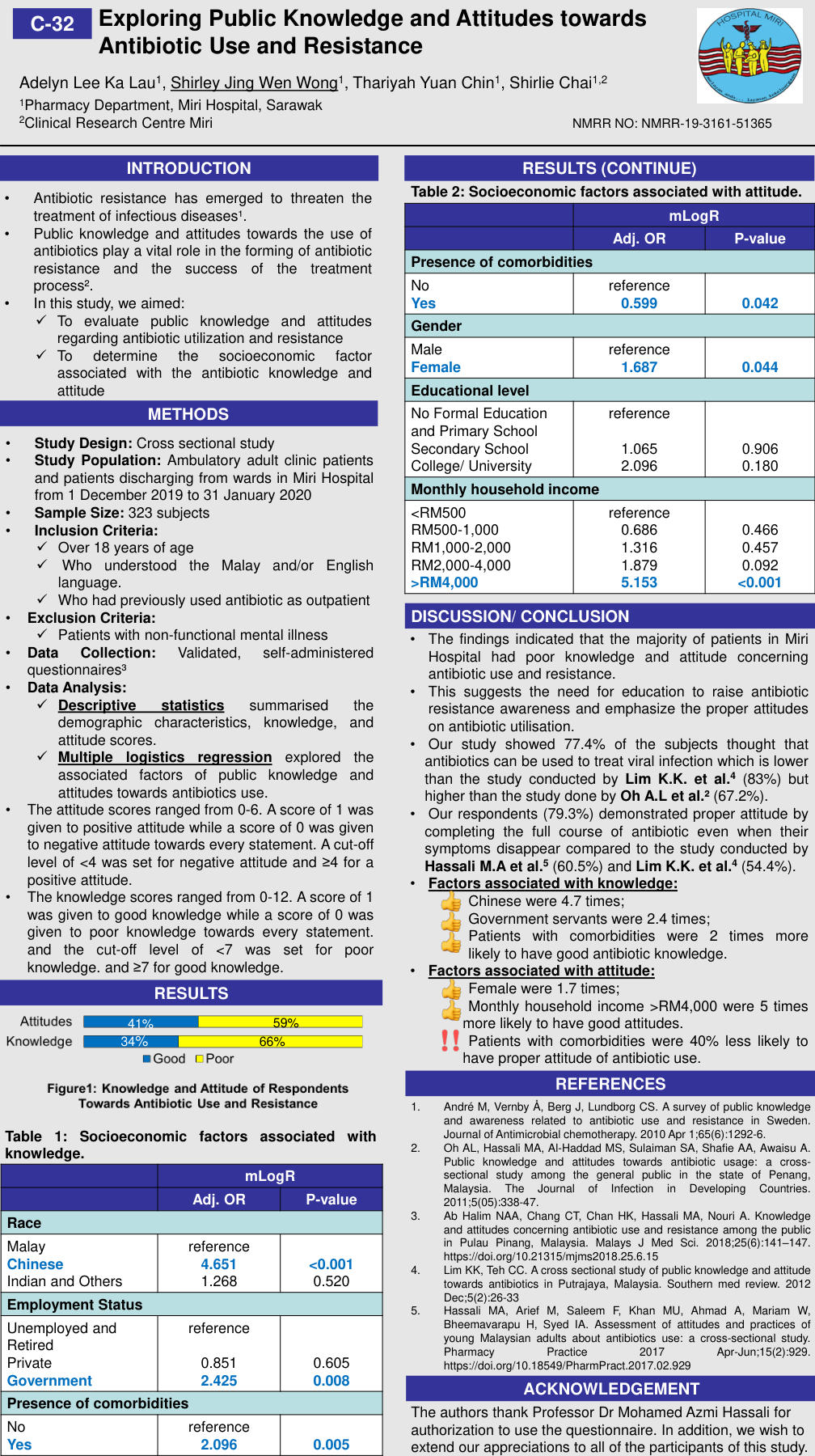
Introduction Antibiotic resistance has emerged to threaten the treatment of infectious diseases. Public knowledge and attitudes towards the use of antibiotics play a vital role in the forming of antibiotic resistance and the success of the treatment process. In this study, we aimed: To evaluate public knowledge and attitudes regarding antibiotic utilization and resistance. To determine the socioeconomic factor associated with the antibiotic knowledge and attitude. Methods Study Design: Cross sectional study • Study Population: Ambulatory adult clinic patients and patients discharging from wards in Miri Hospital from 1 December 2019 to 31 January 2020 • Sample Size: 323 subjects Inclusion Criteria: Over 18 years of age. Who understood the Malay and/or English language. Who had previously used antibiotic as outpatient Exclusion Criteria: Patients with non-functional mental illness Data Collection: Validated, self-administered questionnaires Data Analysis: Descriptive statistics summarised the demographic characteristics, knowledge, and attitude scores. Multiple logistics regression explored the associated factors of public knowledge and attitudes towards antibiotics use. The attitude scores ranged from 0-6. A score of 1 was given to positive attitude while a score of 0 was given to negative attitude towards every statement. A cut-off level of <4 was set for negative attitude and ≥4 for a positive attitude. The knowledge scores ranged from 0-12. A score of 1 was given to good knowledge while a score of 0 was given to poor knowledge towards every statement. and the cut-off level of <7 was set for poor knowledge. and ≥7 for good knowledge. Results [Refer to Poster]. Discussion / Conclusion The findings indicated that the majority of patients in Miri Hospital had poor knowledge and attitude concerning antibiotic use and resistance. This suggests the need for education to raise antibiotic resistance awareness and emphasize the proper attitudes on antibiotic utilisation. Our study showed 77.4% of the subjects thought that antibiotics can be used to treat viral infection which is lower than the study conducted by Lim K.K. et al. 4 (83%) but higher than the study done by Oh A.L et al. (67.2%). Our respondents (79.3%) demonstrated proper attitude by completing the full course of antibiotic even when their symptoms disappear compared to the study conducted by Hassali M.A et al. 5 (60.5%) and Lim K.K. et al. 4 (54.4%). Factors associated with knowledge: Chinese were 4.7 times; Government servants were 2.4 times; Patients with comorbidities were 2 times more likely to have good antibiotic knowledge. Factors associated with attitude: Female were 1.7 times; Monthly household income >RM4,000 were 5 times more likely to have good attitudes. Patients with comorbidities were 40% less likely to have proper attitude of antibiotic use.
Conference Information
NMRR
Identifiers
Authors
Adelyn Lee Ka Lau
Pharmacy Department, Miri Hospital, Sarawak
Shirley Jing Wen Wong
Pharmacy Department, Miri Hospital, Sarawak
Thariyah Yuan Chin
Pharmacy Department, Miri Hospital, Sarawak
Shirlie Chai
Pharmacy Department, Miri Hospital, Sarawak